
Short answer: An Indian brand should choose a PR firm in Dubai on fit with its UAE brief, not on a ranking. Ask who leads the account on the ground, which UAE outlets they know, how the story changes between India and the UAE, how they handle Arabic, how they check creator permits, and what you will see by day 90.
Last updated: 19 November 2026
Choosing a PR firm in Dubai means matching a firm’s UAE media relationships, language capability and regulatory know-how to the specific audiences, emirates and outcomes your brand needs, then testing those claims before you sign.
Most pages that rank for this question are lists of firms. Lists can help you build a shortlist, but they cannot tell you which firm fits an Indian brand entering the UAE. This guide gives you the questions to ask, what a good answer sounds like, the red flags, and what the first 90 days should produce. It draws on how our own Dubai and UAE practice runs cross-border work from India.
Why is a UAE PR brief different for an Indian brand?
- Two audiences, not one. For many Indian brands, the first UAE customers already know the brand from home and are reached through community media, Indian-language content and diaspora creators. Growing beyond them means UAE business, trade and lifestyle media, and creators who speak to residents of every background.
- Two languages. For consumer categories and government-facing work, English-only communication limits reach and can read as transient.
- Emirate-level differences. Audience, regulation and media differ by emirate. A single “UAE strategy” is often a Dubai strategy applied elsewhere.
- Different rules for creators. Promotional content published from within the UAE needs an Advertiser Permit (more below), on top of the ASCI rules you already follow in India.
- Content sensitivity. Local norms around imagery, language and subject matter are specific. A sensitivity review before publication should be routine.
A firm that does not raise these points in its first conversation with you is probably planning a Dubai version of your Indian press plan. Our UAE market entry work starts with exactly these questions.
What should you ask a PR firm in Dubai before you sign?
Use these twelve questions in every pitch meeting. The middle column is what a good answer sounds like; the last column is what should make you pause.
| Question | A good answer | Red flag |
|---|---|---|
| 1. Who will actually lead our account, and where are they based? | Named senior people, with time share stated, at least one of whom works in the UAE | Senior names in the pitch, junior names in the contract |
| 2. Which UAE outlets and beats cover our category, and who writes for them? | A specific map by outlet, beat and language, including trade titles | A generic list of the biggest titles in the country |
| 3. What UAE coverage have you earned recently, in our category or a neighbouring one? | Recent earned examples they can show, with the difference between earned and paid made clear | Only paid features, or no examples at all |
| 4. How will our story change between India and the UAE? | One narrative with a separate execution plan for each market | The Indian press release translated and sent again |
| 5. Which audience comes first: Indian-origin communities or the wider UAE market? | A plan for both tracks, with the sequence explained | Treating the UAE as one audience |
| 6. Which parts of our plan need Arabic, and who writes and reviews it? | A clear answer by category and audience, with a named reviewer | Machine translation or ‘we will handle it later’ |
| 7. Is this a Dubai plan or a UAE plan? | An emirate-level view: which emirates matter for you and why | A Dubai plan applied everywhere |
| 8. How do you check creator permits and disclosure? | Permit status and number, the account registered to it, and disclosure on every post, before anything goes live | No mention of the Advertiser Permit |
| 9. What will you refuse to do? | Clear limits: no paid placement passed off as editorial, no claims you cannot prove | Guaranteed headlines in named outlets |
| 10. How will you report on both markets? | One monthly report covering India and the UAE in the same format | Separate reports nobody can compare |
| 11. What should we see at day 30, 60 and 90? | Concrete outputs at each checkpoint | Only a coverage count at the end |
| 12. Which professional bodies and licences does the firm hold? | A UAE trade licence and, often, membership of a professional body such as MEPRA | Reluctance to share either |
If you are also comparing firms for India, our checklist for choosing a PR firm in India covers the questions that apply in both markets, such as team, scope and reporting.
Planning a UAE launch from India? Tell us the category, the emirates and the audiences you need. In one call we will tell you what a realistic first 90 days looks like and what to ask any firm you are considering. Book a consultation with Influence.
Indian-origin communities or the wider UAE market: who comes first?
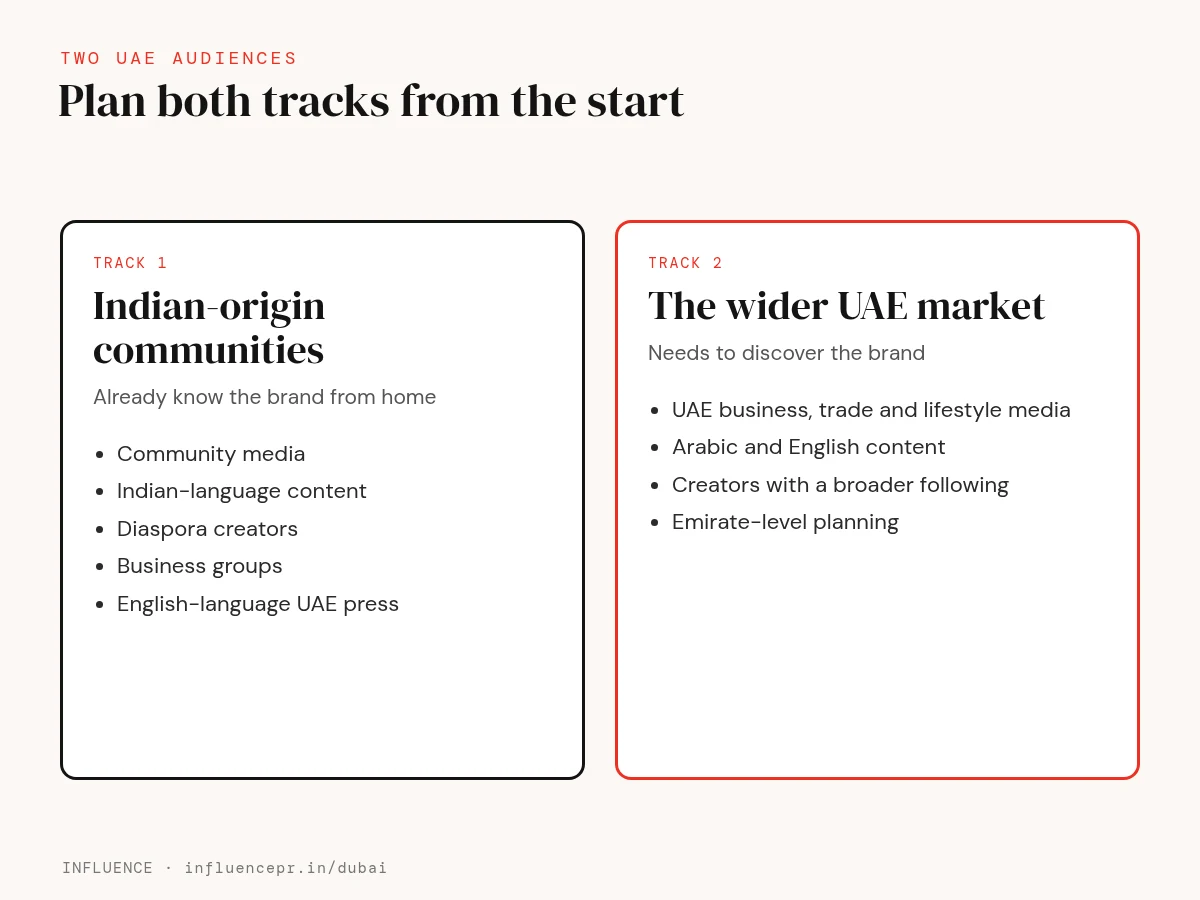
Most Indian brands should plan both from the start, even if the first months focus on one. The Indian-origin track can move faster, because many of these customers already know the brand from home; it runs through community media, Indian-language content, diaspora creators and business groups, alongside English-language UAE press. The wider-market track takes longer and needs UAE business, trade and lifestyle media, Arabic and English content where the category needs it, and creators with a broader following. A brand that only plans the first track tends to stall at its first audience.
What should you check about creator permits?
If your UAE plan includes creators, ask the firm how it checks permits before anything goes live. The rules changed this year:
- The permit is mandatory. Gulf News reported that from 1 February 2026, individuals advertising on social media in the UAE must hold a valid Advertiser Permit from the UAE Media Council. It applies to paid and unpaid promotion by citizens, residents and visitors creating content from within the UAE (Gulf News, 1 February 2026).
- Brands share the responsibility. The same report says organisations must verify that any advertiser they work with holds a valid permit, and that non-compliance can lead to fines of up to Dh1 million.
- Visiting creators are covered too. Visitor permits are available for content creators registered with licensed advertising or talent agencies. The same report says visitor permits run for three months, are renewable and are applied for through licensed UAE-based agencies, so an Indian creator flying in to film your Dubai launch needs that route sorted before the trip.
- The permit is visible. Permit holders must display their permit number on their accounts. The National Media Authority lists the individual permit as free for the first three years and AED 1,000 after that, with a service time of three working days (National Media Authority).
A good firm will show you its checklist: permit status and number, the account registered against the permit, and disclosure on every post. See how we run creator partnerships across both markets.
Dubai firm, Indian firm with a UAE office, or a global network?
There is no single right model. Each has strengths and a question you should ask:
| Model | Typical strengths | What to check |
|---|---|---|
| A Dubai-based firm | Deep UAE media relationships, Arabic capability, local sensitivities | May not know your Indian story, customers or media; ask how the India side is handled |
| An Indian firm with a UAE office | Knows your brand and Indian media, can run one narrative across both markets | Check that the UAE team is real, on the ground and earning UAE coverage now |
| A global network firm | Scale, multi-market reach, established processes | Senior attention can be thin for a mid-sized brand; ask who leads day to day |
Whichever model you choose, ask for one narrative across both markets and one report that covers both. That is the core of how we run public relations consulting for cross-border clients.
What should the first 90 days in the UAE produce?
For most consumer categories, plan three to five months from market read to launch. You should still see progress at each checkpoint:
| Checkpoint | What you should see |
|---|---|
| Day 30 | A UAE media map by outlet, beat and language; a two-market narrative; a sensitivity review of your content; a permit-checked creator shortlist if creators are in scope |
| Day 60 | First pitches out to named UAE journalists; spokesperson briefed for UAE interviews; launch or announcement plan with dates; Indian coverage timed to the UAE news |
| Day 90 | Replies, interviews or first earned pieces in outlets your UAE buyers read; one report covering both markets; a plan for the next quarter so the launch is not a single spike |
If you are an early-stage company, our 90-day PR plan for startups in India covers the same discipline for the Indian side of the story.
Which red flags should make you walk away?
- Guaranteed coverage. Editors decide what runs. A guaranteed headline in a named outlet is advertising, which should be disclosed as paid.
- No answer on permits. If a firm proposes a creator programme without mentioning the Advertiser Permit, the risk sits with you.
- Translation as strategy. Your Indian release translated into Arabic is not a UAE plan.
- A price before a brief. A quote that arrives before anyone has asked about your audiences, emirates and goals is a price for activity, not for an outcome. Our guide to what PR costs in India explains the cost drivers that apply in both markets.
- No professional footprint. A firm working in the UAE should be able to share its trade licence. Membership of a professional body is one more signal of commitment to the profession: MEPRA, for example, describes itself as the region’s leading body for public relations and communication professionals, founded in 2001 with more than 350 members (MEPRA, About us).
Frequently asked questions
How do I choose a PR agency in Dubai as an Indian brand?
Start with the brief, not the shortlist: which UAE audiences you need, which emirates, which languages and what the launch must achieve. Then test each firm on cross-border questions: who leads the work, which UAE outlets and beats they know, how they handle Arabic and English, how they check creator permits, and whether they can report on India and the UAE in one format.
Do I need a Dubai-based PR firm, or can my Indian PR firm handle the UAE?
Either can work if the team has genuine UAE media relationships, a presence on the ground and an understanding of local rules and sensitivities. Ask an Indian firm who in its team works in the UAE and which UAE coverage it has earned recently; ask a Dubai firm how it will handle the Indian side of your story.
Do creators in the UAE need a permit to promote an Indian brand?
Yes, if they publish promotional content from within the UAE. Gulf News reported that the UAE Media Council’s Advertiser Permit became mandatory from 1 February 2026 for paid and unpaid promotion, that organisations must check the creators they work with hold a valid permit, and that non-compliance can lead to fines of up to Dh1 million.
Do we need Arabic for PR in the UAE?
For consumer categories and government-facing work, usually yes. English-only communication limits reach and can read as transient. Ask the firm which parts of your plan need Arabic and who will write and review it.
How long does it take to launch an Indian brand in the UAE with PR?
For most consumer categories, plan for three to five months from market read to launch. Judge the first 90 days on visible groundwork: a UAE media map, a two-market narrative, a permit-checked creator shortlist and the first pitches, not on a promised number of articles.
Want a second opinion on a UAE PR proposal? Send us the brief and the proposal you are weighing. We will come back with the questions we would ask before signing, whether or not you work with us. Book a consultation with Influence.
Sources
- Gulf News, New UAE law: Advertiser Permit now mandatory for influencers and creators for social media (1 February 2026)
- National Media Authority, Permit for an individual to provide advertising or media content on social media and other digital platforms
- MEPRA, About us
- Influence, Dubai and the UAE (service page: cross-border work, two audiences, creator permit checks)
- Influence, UAE Entry (service page: emirate-level read, Arabic, launch timeline)
2 responses