
Short answer: A PR agency earns attention and trust for a company from journalists, customers, investors and other audiences, mainly through coverage it does not pay for. Week to week that means positioning, media relations, press materials, spokesperson preparation, crisis support and reporting. It cannot guarantee earned coverage, and it cannot turn a non-story into news.
Last updated: 14 November 2026
A PR agency is an outside firm a company pays to earn attention and trust from the people who matter to it, mainly through earned coverage and other third parties rather than paid advertising.
The UK’s Chartered Institute of Public Relations (CIPR) puts the purpose simply: public relations is about reputation, which it describes as the result of what you do, what you say and what others say about you (CIPR, About PR). A PR firm works mostly on the third part, what others say, and helps you get the first two right so there is something worth saying.
This guide is written for founders who are about to hire PR help for the first time, or who have hired it and are not sure what they are getting. It covers what the work actually is, the types of PR you can buy, what the Indian market looks like in 2026, what no PR firm can promise, and what the first 90 days should produce.
What does a PR agency actually do, week to week?
Strip away the jargon and the work falls into eight activities. Use the last column to check whether you are getting each one:
| Activity | What it involves | What you should see |
|---|---|---|
| Positioning and message | Agreeing what you stand for and the claims you can prove, written as a one-page message house | A position you can defend in front of a journalist |
| Media relations | Building relationships with the journalists who cover your category and pitching them individually written stories | A named target list by beat and outlet, not a distribution list |
| Story development | Turning launches, data and opinions into angles a reporter can use, built on a claim rather than a milestone | A story bank of angles, each with its proof |
| Press materials | Releases where they suit the news, fact sheets, founder bios and image kits | Materials ready before any pitch goes out |
| Spokesperson preparation | Briefing founders and leaders before interviews, including hostile or unexpected questions | A briefing note before every interview |
| Thought leadership | Bylines, interviews, podcasts and speaking slots for named leaders | A calendar of placements that build on each other |
| Issues and crisis | Holding statements, response plans and monitoring when something goes wrong | A plan and a holding statement in hours, not days |
| Monitoring and reporting | Tracking coverage, share of voice and, increasingly, how you show up in search and AI answers | A monthly report on what ran, where and what it changed |
Not every engagement includes all eight. A launch brief may be mostly media relations and press materials; a founder brief is mostly thought leadership and spokesperson preparation. What should be in every engagement is the first row and the last one: a clear position at the start, and honest reporting on what changed.
What are the types of PR?
Lists of “seven types of PR” circulate widely, but there is no official list, and the categories overlap. This is the grouping we use with founders, based on who the work is for:
| Type of PR | What it covers | Who usually needs it | Where Influence covers it |
|---|---|---|---|
| 1. Media relations | Earned coverage with journalists who cover your category | Almost every company with a story to tell | media relations |
| 2. Founder and executive PR | Profiles, interviews, bylines and stages for named leaders | Founders raising, hiring or selling on trust | founder press and profiles |
| 3. Corporate and investor communications | Results, funding, governance and capital markets audiences | Funded and listed companies | public relations consulting |
| 4. Crisis and issues management | Preparing for and responding to events that threaten reputation | Anyone, ideally before they need it | crisis communications |
| 5. Public affairs and government relations | Policy, regulators and government stakeholders | Regulated sectors and large employers | public affairs |
| 6. Internal communications | Messages to employees and through leaders | Companies growing fast or going through change | Usually part of a wider brief |
| 7. Creator and digital PR | Creators, online coverage, search results and AI answers | Consumer brands and anyone researched online | AI search visibility |
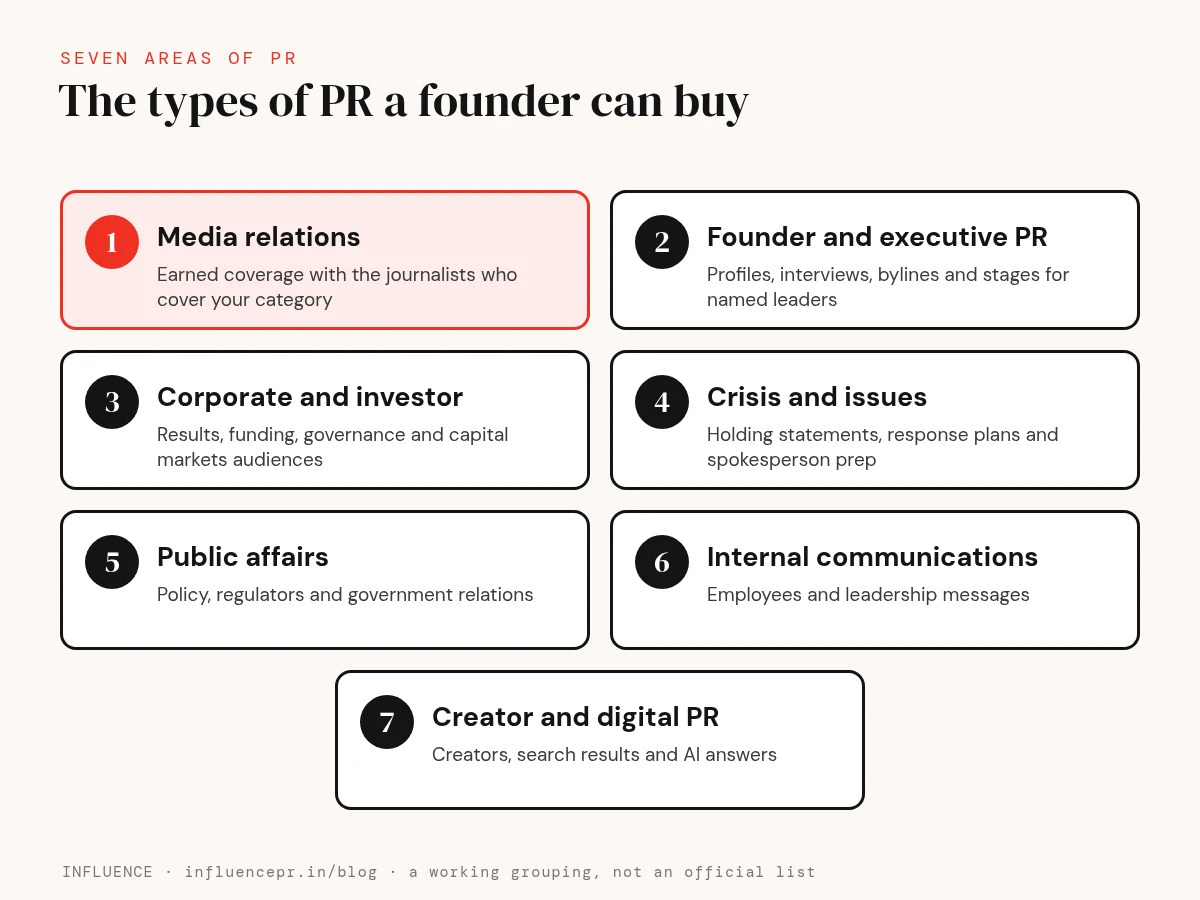
Most companies need two or three of these at a time. An early-stage founder usually starts with founder PR and media relations; a company preparing to raise adds investor communications; a consumer brand adds creator and digital PR. If someone sells you all seven at once, ask which three will matter in the next six months.
Not sure which type of PR you need first? Tell us what you are trying to change: sales, hiring, a fundraise or a reputation problem. In one call we will tell you which work matters now and which can wait. Book a consultation with Influence.
What does the Indian PR market look like in 2026?
The industry’s own survey gives a useful picture of what Indian companies are buying. PRCAI’s SPRINT 2026 report, produced with Ipsos, found (Ipsos and PRCAI, 5 July 2026):
- A growing market. The Indian PR industry grew 11% in FY26 to Rs 3,230 crore and is expected to reach Rs 4,500 crore by 2030.
- More start-up buyers. Start-ups’ share of top client categories rose from 6% in 2022 to 22% in 2026.
- A more strategic role. 46% of communicators say PR plays a direct role in driving business outcomes.
- AI is changing discovery. 83% agree earned media is gaining importance because large language models prioritise credible, third-party sources over paid placements, and 27% already measure discoverability inside AI and LLM search.
- Measurement is still weak. 92% of corporate communicators say the industry needs a standardised measurement system, yet only 46% allocate a separate budget for it.
For a founder, the practical reading is this: earned coverage now feeds not only readers but also the AI tools your buyers use to research you, and you should agree how results will be measured before work starts, because the industry has no standard. If AI answers about your company are thin or wrong, our guide on what to do when ChatGPT recommends your competitors explains the link between coverage and AI answers.
What can a PR agency not do?
- Guarantee earned coverage. Editors decide what runs. Guaranteed placement is paid placement, which is a legitimate but different product, and it should be disclosed as paid.
- Make a non-story into news. A funding round or a launch usually earns a paragraph. A claim about your market that a journalist finds worth testing earns a feature. A good firm will tell you when your story is not news yet, and what would make it news.
- Deliver overnight. For earned editorial coverage of a founder or company, we plan for three to five months, assuming there is a genuine story.
- Fix a product or service problem. If customers are unhappy for good reason, communication can explain what you are changing; it cannot replace the change.
- Replace your own voice. Journalists, investors and candidates want to hear from the founder. A firm can prepare you, open doors and draft with you, but it cannot be you.
What should the first 90 days of a PR engagement produce?
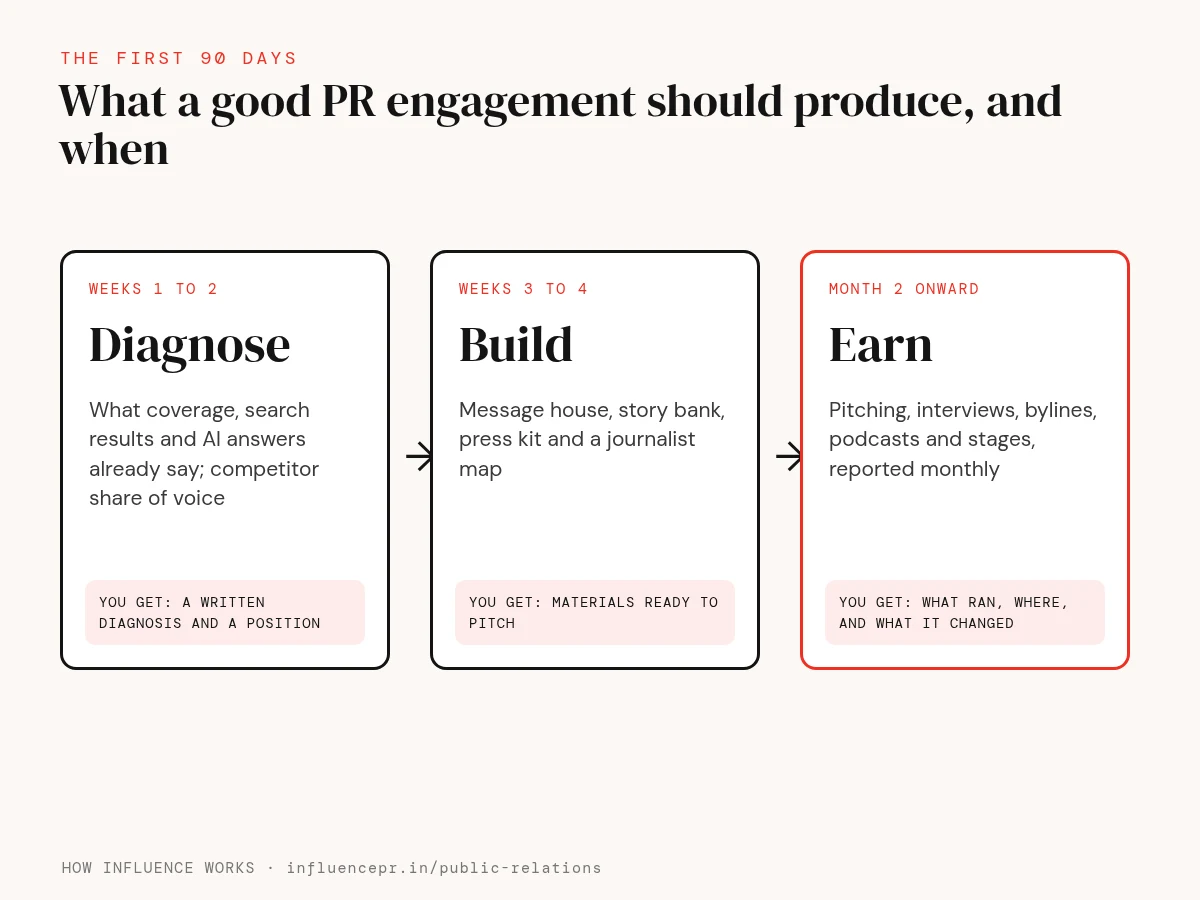
Whoever you hire, you should be able to see progress in three stages. This is how we run a public relations engagement at Influence:
- Weeks 1 to 2, diagnose. Read what the market already says about you: coverage, search results, AI answers and competitor share of voice. Output: a short written diagnosis and a position you can defend in front of a journalist.
- Weeks 3 to 4, build. A message house, a story bank of six to ten angles, a press kit and a journalist map covering national business press, trade titles and the regional outlets your buyers read.
- Month 2 onward, earn. Pitching, interviews, bylines, podcasts and stages, sequenced so each placement supports the next, with a monthly report on what ran, where and what it changed.
If a proposal skips straight to “press release distribution” in week one, ask what the story is and who it is for. You can see the full scope and deliverables on our public relations consulting page. If you run a startup, our 90-day PR plan for startups in India breaks the same sequence down by funding stage.
Agency, consultancy or in-house: which do you need?
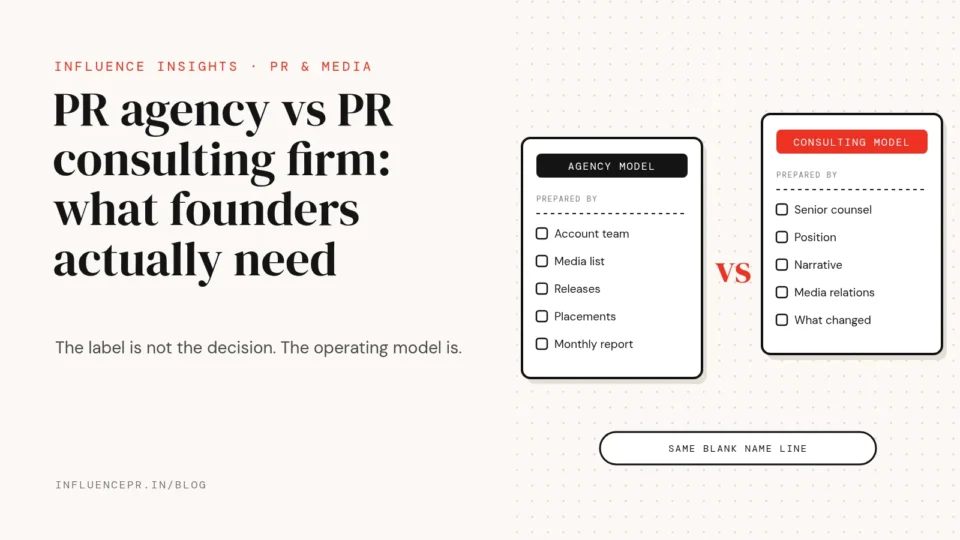
The work above can be bought in different ways. An agency model often sells a volume of activity delivered by a larger team; a consulting model sells senior judgement and accountability for an outcome; an in-house hire gives you full-time focus but one person’s network. Our comparison of PR agency and PR consulting firm models sets out the differences, and our checklist for choosing a PR partner in India helps you test a proposal. For budgets, our guide to what PR costs in India explains the cost drivers. Founders in the capital region can also see how we work on PR in Gurugram.
Frequently asked questions
What is the full form of PR?
PR stands for public relations: the work of earning attention and trust from the people who matter to an organisation, such as journalists, customers, investors and employees, mainly through coverage and third parties rather than paid advertising. A PR agency or PR consulting firm is an outside firm that does this work for clients.
What is the meaning of a PR agency?
A PR agency is an outside firm a company pays to earn attention and trust from the people who matter to it, such as journalists, customers, investors, employees and regulators, mainly through earned coverage and other third parties rather than paid advertising. Some firms in India describe themselves as PR consultancies or consulting firms; the core work is the same, but how they are staffed and paid can differ.
What are the 7 types of PR?
There is no official list of seven. A practical grouping for founders is: media relations; founder and executive PR; corporate and investor communications; crisis and issues management; public affairs and government relations; internal communications; and creator and digital PR, which now includes how you appear in search results and AI answers. Most companies need two or three of these at a time, not all seven.
What does a PR consultancy do?
Much the same work as a PR agency: positioning, media relations, spokesperson preparation, crisis support and reporting. The difference is usually in the model. A consultancy tends to sell senior advice and accountability for an outcome, while an agency model often sells a volume of activity delivered by a larger team. Our comparison of the two models explains how to tell which one a proposal is really offering.
Can a PR agency guarantee media coverage?
Not for earned coverage. Editors decide what runs. If a firm guarantees a placement, it is usually selling paid placement, which is a legitimate product but a different one, and it should be disclosed as paid. A good firm will tell you plainly when a story is not news yet and what would make it news.
How long does PR take to show results?
For earned editorial coverage of a founder or company, we plan for three to five months, assuming there is a genuine story. The first weeks go into diagnosis, positioning and press materials, and pitching starts from the second month. Coverage that appears much faster is often paid placement.
Want to see what the first 90 days would look like for you? Share your company, your story and the audiences that matter, and we will come back with a written view of where you stand and what PR can realistically change. Book a consultation with Influence.
Sources
- Ipsos and PRCAI, Indian Public Relations market to reach Rs 4,500 crore by 2030: PRCAI SPRINT 2026 (5 July 2026)
- Chartered Institute of Public Relations, About PR (definition of public relations)
- Influence, Public Relations (service page: how an engagement works)
- Influence, Media Relations (service page: guaranteed placement FAQ)
- Influence, Press and Profiles (service page: time to first coverage)
3 responses