
Short answer: PR for a startup in India works best as a 90-day sequence: two weeks to diagnose what the market already says and whether you have a story, two weeks to build a position, story bank and press kit, then two months of individually written pitching. Expect earned coverage in three to five months, not in week one.
Last updated: 17 November 2026
PR for a startup is the work of earning attention and trust from customers, investors, hires and journalists through coverage and third-party credibility you do not pay for, sequenced around the company’s next milestone.
Most pages that rank for this topic are service pages or lists of tips. This guide is the plan we would give a founder on day one: what to check before you start, what happens in each fortnight, what PR should do at your stage, what to refuse, and how to tell at day 30, 60 and 90 whether it is working. It follows the same Diagnose, Build, Earn sequence we use for our own public relations consulting work.
Why are Indian startups buying more PR in 2026?
Two sets of numbers explain why PR has moved up the startup to-do list.
- There are more startups competing for the same attention. India had more than 2.62 lakh DPIIT-recognised startups as of November 2026 and is the world’s third-largest startup ecosystem, according to the government’s National Entrepreneurship Day backgrounder; 52% of recognised startups come from non-metro cities (PIB, 9 November 2026).
- Startups are now a large share of PR buyers. PRCAI’s SPRINT 2026 report, produced with Ipsos, found start-ups nearly quadrupled their share of top client categories, from 6% in 2022 to 22% in 2026, in an industry that grew 11% in FY26 to Rs 3,230 crore and is expected to reach Rs 4,500 crore by 2030 (Ipsos and PRCAI, 5 July 2026).
- Earned coverage now feeds AI answers too. In the same survey, 83% agreed earned media is gaining importance because large language models prioritise credible third-party sources over paid placements, and 66% agreed that positioning paid content as earned is weakening audience trust.
- Regional media matters more. Regional PR’s share of industry revenue rose from 10% three years ago to 19% in 2026, which fits a startup base where more than half of companies sit outside the metros.
The practical reading for a founder: more companies are pitching the same journalists, so a generic launch release gets lost; earned coverage now shapes what search engines and AI tools say about you; and the regional and trade outlets your buyers read can matter as much as one national headline.
Before day 1: do you have a story?
PR amplifies a story; it cannot invent one. Run this six-point check before you hire anyone or send a single pitch. If you cannot tick at least four, spend the first month fixing the gaps.
- You can say what you do, for whom, and why it matters now, in one sentence a stranger understands.
- You have at least one claim a journalist could test: a number, a customer outcome, a piece of data or a contrarian view you can defend.
- The founder is willing to be the face of the company and can give 2 to 3 hours a week to interviews, reviews and writing.
- Your website, LinkedIn and founder bio say the same thing, and searching your company name does not surface something you would rather explain first.
- You know which three audiences matter most in the next six months: customers, investors, hires, partners or regulators.
- Someone can approve quotes and facts within a day, so a journalist’s deadline does not pass while you wait for sign-off.
If the check exposes that your company is hard to find or explain online, start with the basics in our guide for founders who are invisible online, then come back to this plan.
What does a 90-day PR plan for a startup look like?
We call the sequence Diagnose, Build, Earn. Each phase has a job, a set of inputs only the founder can supply, and an output you should be able to see.
| Phase | What happens | What the founder supplies | What you should see |
|---|---|---|---|
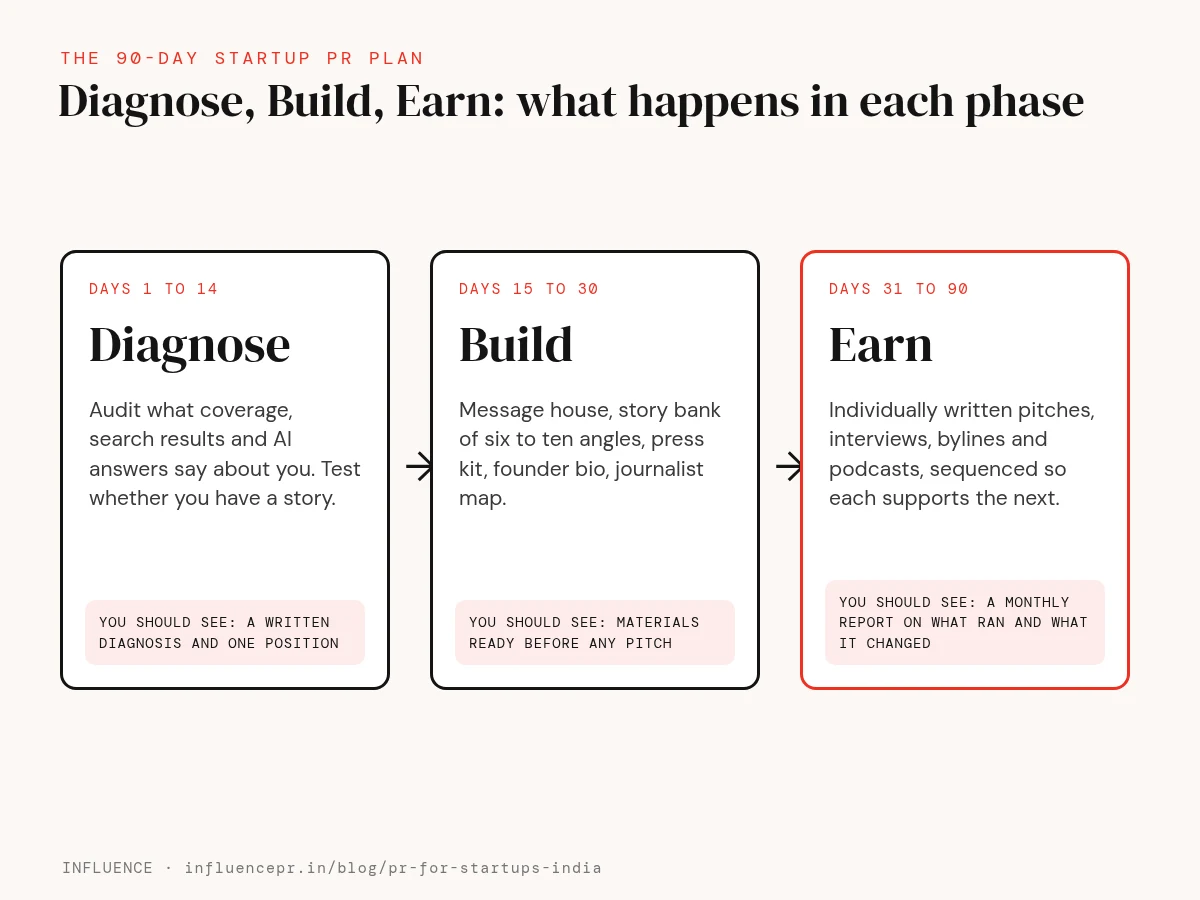
| Days 1 to 14: Diagnose | Audit coverage, search results and AI answers about you and three competitors; interview the founder and two or three customers; test the story against what journalists in your category have covered recently | Founder time for a long interview, access to metrics you are willing to make public, a list of past coverage | A short written diagnosis and one position you can defend in front of a journalist |
| Days 15 to 30: Build | Write the message house; build a story bank of six to ten angles, each with its proof; prepare the press kit (fact sheet, founder bio, images); map journalists by beat and outlet, including the regional and trade titles your buyers read; brief the spokesperson | Approvals on facts and quotes, two or three customer references who are willing to speak, product images | Materials ready before any pitch goes out, and a named target list rather than a distribution list |
| Days 31 to 60: Earn, first wave | Individually written pitches for the strongest two or three angles; founder bylines and podcast pitches; one data or opinion piece that gives journalists a reason to call you back | Fast turnaround on interview requests and drafts; the founder’s own view, not a sanitised one | Replies and interview requests from named journalists, even before stories run |
| Days 61 to 90: Earn, compound | Follow up on interviews; turn each piece of coverage into founder LinkedIn posts, sales material and website proof; pitch the next angles; review what worked and drop what did not | Feedback from sales and hiring on what prospects and candidates mention | A first set of earned pieces, a monthly report on what ran and what it changed, and a plan for the next quarter |
Days 1 to 14: Diagnose
Start by reading what the market already says about you. Search your company and founder names, ask two or three AI assistants what they know about you and your competitors, and list every piece of coverage you have had. Then test your story against what journalists in your category have actually written in the last three months. The output is a short written diagnosis and one position: the claim you want to be known for, and the proof behind it.
Days 15 to 30: Build
Turn the position into materials. A one-page message house; a story bank of six to ten angles, each built on a claim rather than a milestone; a press kit with a fact sheet, founder bio and images; and a journalist map that covers national business press, trade titles and the regional outlets your buyers read. Brief the founder before any interview, including the question you least want to be asked.
Days 31 to 90: Earn
Now pitch, one journalist at a time. Lead with the two or three strongest angles, add founder bylines and podcast pitches, and give journalists a data point or an opinion that makes you worth calling back. From day 60, compound what runs: reuse each piece on founder LinkedIn, in sales decks and on your website, and pitch the next angles from the story bank. Our startup PR and media coverage programme is built around this phase.
Not sure you have a story yet? Send us your one-line pitch and the audience you most need to reach. In one call we will tell you whether it is news today, what would make it news, and what to do in the meantime. Book a consultation with Influence.
What should PR do at each startup stage?
The same 90 days look different at pre-seed and at Series B. Match the work to the audience you need next.
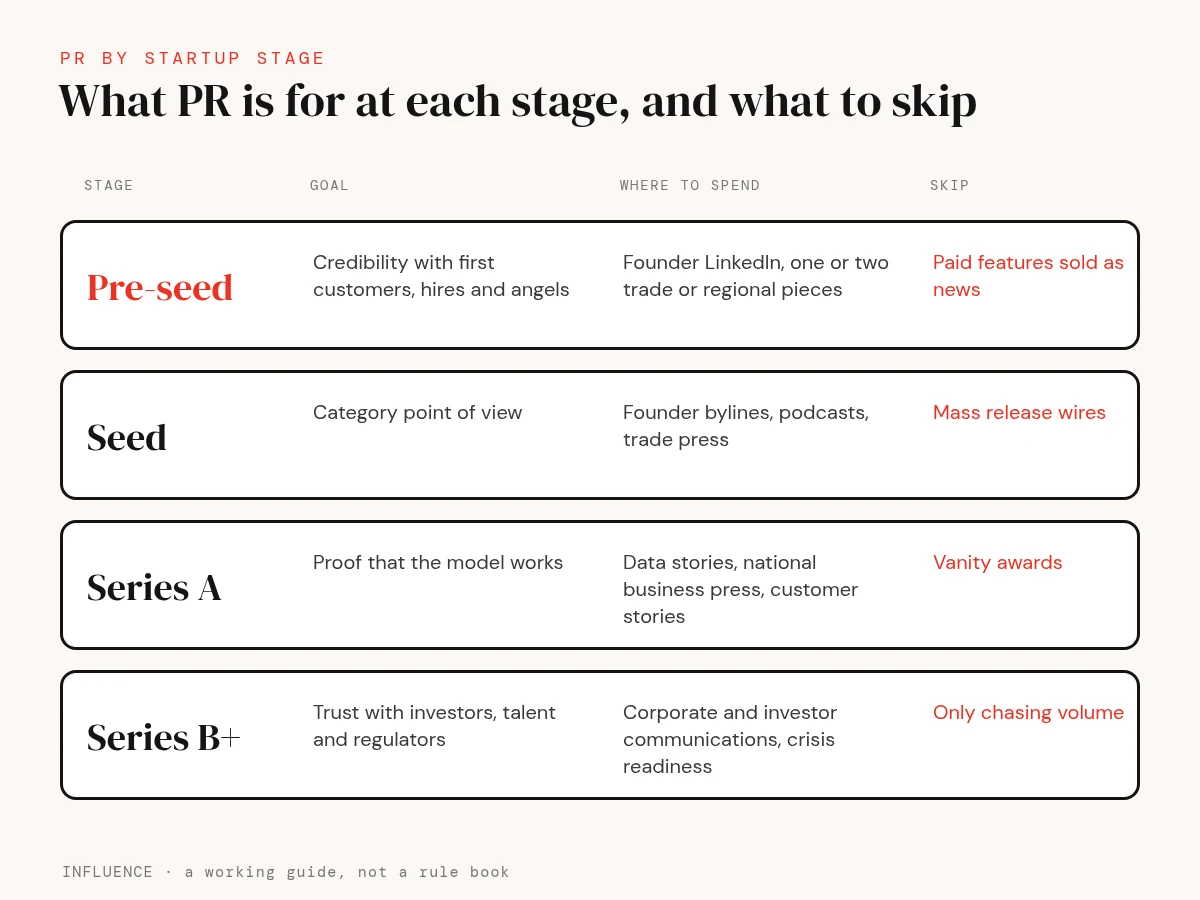
| Stage | What PR is for | Where to spend effort | What to skip |
|---|---|---|---|
| Pre-seed | Credibility with first customers, early hires and angels | Founder LinkedIn, a clear founder bio, one or two trade or regional pieces | Paid features presented as news; national launches before there is proof |
| Seed | A point of view on your category that people associate with the founder | Bylines, podcasts, trade press, founder interviews | Mass press release wires for news that is not news |
| Series A | Proof that the model works | Data stories, customer stories, national business press, selected stages | Vanity awards and lists you pay to enter |
| Series B and beyond | Trust with investors, senior talent, partners and regulators | Corporate and investor communications, executive profiles, crisis readiness | Chasing coverage volume over the audiences that matter |
Across every stage, the founder is the most credible spokesperson the company has. Journalists, investors and candidates want to hear from the person who started it, which is why most early-stage PR is really founder authority work.
Funding announcements: when does PR help, and when does it hurt?
A funding round is the moment most Indian startups first think about PR, and often the wrong place to start. A round on its own usually earns a short news item. What earns a feature is the claim behind it: what the money will change in your market, and the proof that you can do it.
- Start early. We recommend starting narrative work two to four quarters before you intend to raise. Starting in the same month as the process is possible, and it shows.
- Keep claims inside your numbers. Visibility can hurt a raise if public claims outrun the numbers an investor will see in diligence. Audit what is already on the record before you add to it.
- Plan the day after. Line up a founder interview, a byline or a data story for the weeks after the announcement, so the round becomes the start of a story rather than the whole of it.
Our raise narrative work covers this preparation in detail.
What should a startup not buy?
- Paid placement sold as editorial. Paid articles are a legitimate product when they are disclosed as paid, but they do not carry the credibility of earned coverage. If a provider guarantees a headline in a named outlet within a week, you are buying advertising.
- Mass release wires for news that is not news. Press releases work for regulatory and financial announcements. For founder stories and product launches, an individually written pitch to a journalist who covers your category works far better.
- Coverage counts as the only measure. Ask how results will be measured before work starts. PRCAI’s SPRINT 2026 survey found 92% of corporate communicators agree the industry needs a standardised measurement system, yet only 46% allocate a separate budget for it.
- Everything at once. A startup rarely needs media relations, crisis retainers, awards, events and influencer campaigns in the same quarter. Pick the two or three that serve the next milestone.
If you have already run a launch that got no coverage, our post on why launches get no press walks through the usual causes.
How do you know if startup PR is working?
Use three checkpoints. Coverage should not be expected at day 30, but the groundwork should be visible.
| Checkpoint | Questions to ask |
|---|---|
| Day 30 | Is the position written down and agreed? Is the press kit finished? Is there a named journalist list? Has the founder been briefed for a hostile question? |
| Day 60 | Have named journalists replied, asked for data or booked interviews? Is at least one byline or podcast in motion? Are you hearing which angles land and which do not? |
| Day 90 | Have you earned your first pieces in outlets your buyers read? Do search results for your company and founder name look better? Are sales, hiring or investor conversations referring to what ran? Is there a plan for the next quarter based on what worked? |
If the answers at day 60 are mostly no, revisit the story before you add more pitching. More volume rarely fixes a weak angle.
In-house, freelancer or PR firm: who should run it?
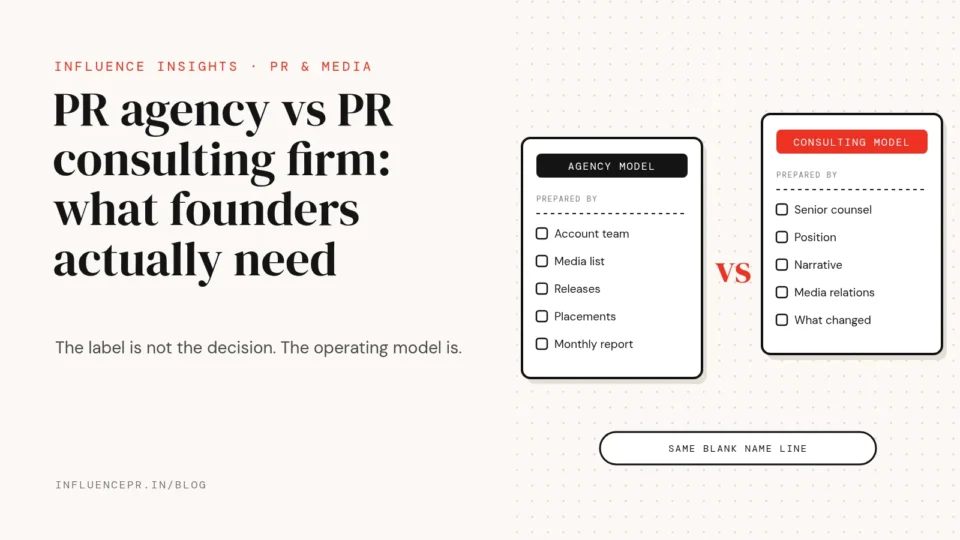
A first in-house hire gives you full-time focus but one person’s network and judgement; a freelancer can be fast and affordable for a single launch; a firm brings senior judgement, wider media relationships and cover across markets. Our comparisons of a PR firm and an in-house team and a PR firm and a freelancer set out the trade-offs. If you are comparing firms, read what a PR firm actually does, our checklist for choosing a PR partner in India, and our explainer on PR agency and PR consulting firm models. For budgets, see what PR costs in India. Startups in the capital region can also see how we work on PR in Gurugram and PR in Delhi NCR.
Frequently asked questions
How much does PR cost for a startup in India?
It depends on scope, seniority and how many markets and languages you need, not on a standard rate card. A focused founder and launch brief costs far less than a multi-city retainer with crisis cover. Our guide to what PR costs in India explains the cost drivers and the questions to ask before you compare quotes.
How long does it take a startup to get its first media coverage?
For earned editorial coverage, plan for three to five months, assuming there is a genuine story. The first month goes into diagnosis, positioning and press materials, and pitching starts in the second month. Coverage that appears within days is often paid placement.
Do startups need a press release?
Rarely, for founder stories. Releases work well for regulatory and financial announcements and as a reference document for journalists. For most startup stories, an individually written pitch to a specific journalist who covers your category works far better than a release sent to a list.
Can PR help a startup raise funding?
It can help investors find you and check you, and PRCAI’s SPRINT 2026 survey found 96% of corporate communication respondents agree PR helps build investor confidence. It can also hurt if public claims run ahead of your numbers. Start narrative work two to four quarters before you plan to raise, not in the month of the round.
Should a startup do PR before product-market fit?
Do a small amount, aimed at credibility rather than reach: a clear founder profile, a point of view on your category and one or two pieces in the trade or regional outlets your first buyers read. Save national launches and big announcements for when you can show proof that the model works.
Want this 90-day plan written for your startup? Share your stage, your next milestone and the audiences that matter, and we will come back with a written view of where you stand and what the first 90 days should produce. Book a consultation with Influence.
Sources
- Press Information Bureau, Backgrounder: National Entrepreneurship Day (9 November 2026)
- Ipsos and PRCAI, Indian Public Relations market to reach Rs 4,500 crore by 2030: PRCAI SPRINT 2026 (5 July 2026)
- Influence, Public Relations (service page: how an engagement works, deliverables)
- Influence, Press and Profiles (service page: time to first coverage, press releases, paid articles)
- Influence, Raise Narrative (service page: when narrative work should start)
3 responses