
Short answer: Most launches get no press because there was no news in it, the pitch reached the wrong journalists, it arrived too late, it read like an advert, or a reporter had nobody and nothing to use. Find which one hit you, then plan the next launch backwards from the coverage moment, eight to twelve weeks out.
Last updated: 3 November 2026
Launch PR is the work of turning a product, store or market launch into a story that journalists can verify, use and publish on their own deadline, rather than an announcement they are asked to repeat.
You booked the venue, shot the film, sent the release and waited. The coverage never came, or it came as two syndicated paragraphs nobody read. It happens to good products all the time, and it is rarely bad luck. This post helps you find what went wrong in about 20 minutes, gives you a press-specific product launch checklist for next time, and shows how to win a second wave of coverage for the launch you have already done.
Why do journalists ignore most launches?
Because most launch pitches are not written for them. Journalists still use PR: in Muck Rack’s 2025 State of Journalism survey, 84% said at least some of their stories start from a PR pitch. But the same survey shows how quickly a pitch gets deleted (Muck Rack, 2025):
- 86% disregard a pitch that is irrelevant to their coverage area.
- 71% disregard pitches that are overly promotional or advertorial.
- 50% disregard pitches that look like a mass email, and 44% those sent repeatedly without a response.
- 69% prefer pitches under 200 words.
The survey analysed 1,515 responses collected in April 2025, mostly from the United States, with respondents from the United Kingdom, Canada and India too, so read it as a direction rather than an Indian benchmark. Time is the other constraint: Cision reports that 67% of journalists get pitches they would like to cover but cannot, because of time or resource limits (Cision, 2025 State of the Media). A launch that is relevant but hard to cover still loses.
Indian communications leaders say the same about timing. “Most clients/brands still look at PR as a last-minute activity and just send a half-baked press release,” Sonam Shah of Treize Communications told exchange4media, and Akanksha Jain of Swiggy said “the approach has moved beyond sending a press release for a new campaign launch” (exchange4media, 2 November 2026).
What went wrong with our launch? Seven common causes
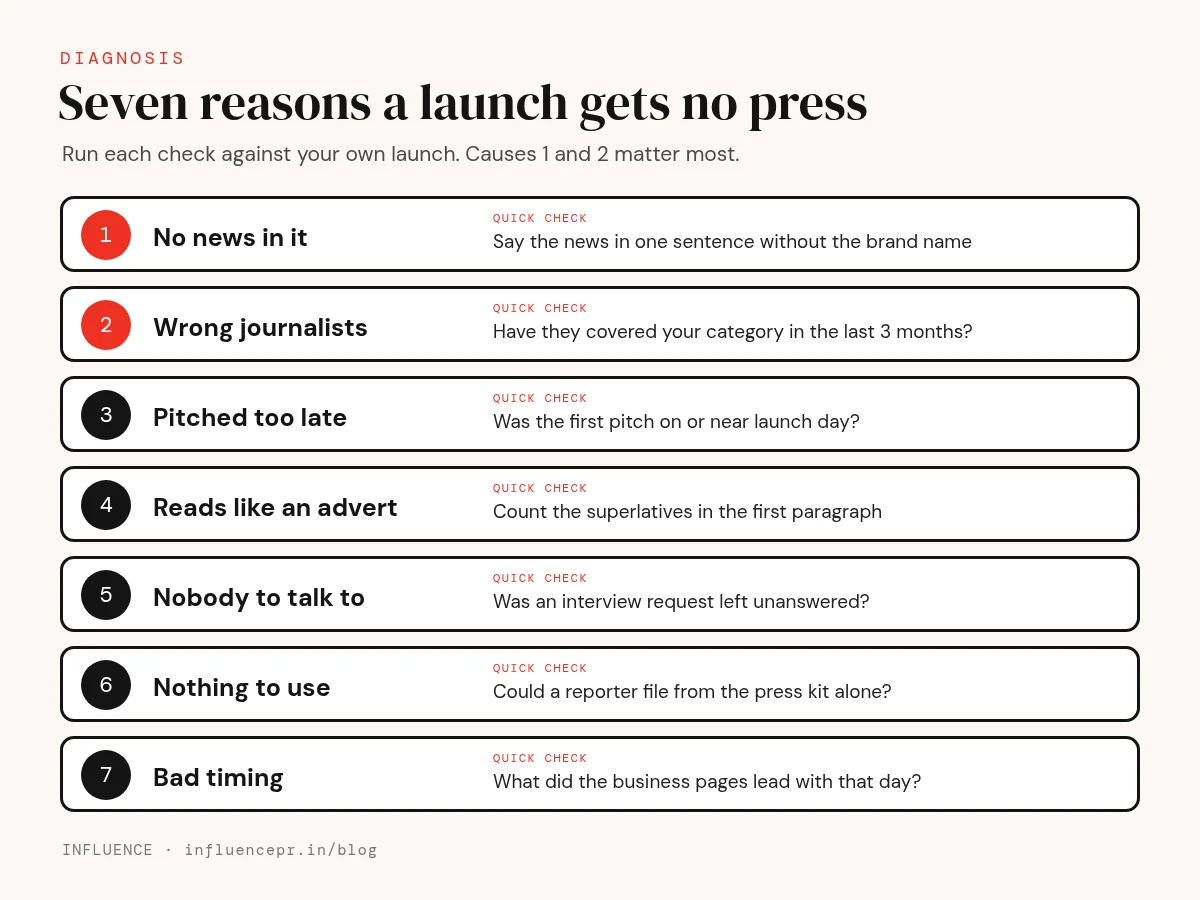
Work down this table with your launch plan, the pitch email and the media list open. Most failed launches have two or three of these at once.
| Cause | What it looks like | How to check in five minutes | Fix for next time |
|---|---|---|---|
| 1. No news in it | A refresh, a new flavour or a new store, described in brand language | Write the news in one sentence without your brand name. If it is not interesting to a stranger, it is not news | Find the angle a reader cares about: a first, a number, a problem solved, a trend you are part of |
| 2. Wrong journalists | A list built by outlet, or bought, not by beat | Open five names on your list. Have they written about your category in the last three months? | Build the list reporter by reporter from their recent stories; trade and regional press included |
| 3. Pitched too late | First contact on launch day or the day before | Check the date of your first pitch against launch day | Brief priority journalists under embargo one to two weeks before; plan the whole effort eight to twelve weeks out |
| 4. Reads like an advert | Adjectives, slogans, a press release pasted into the email | Count the superlatives in the first paragraph | A short, plain pitch: the news, why it matters to their readers, what you can offer |
| 5. Nobody to talk to | The founder was busy, no spokesperson, no customer willing to speak | Did any journalist ask for an interview you could not give? | Name and brief two spokespeople; line up one customer or expert voice in advance |
| 6. Nothing to use | No usable images, no facts sheet, no data, samples not ready | Could a reporter file a story from your press kit alone, today? | A press kit ready before the first briefing: facts, images, spokesperson bios, data with sources |
| 7. Bad timing | Launch day clashed with a bigger story, a holiday or a results day | Look at what the business pages led with that day | Check the news and festival calendar before fixing the date; keep a fallback day |
Causes 1 and 2 matter most. A strong story can survive late timing; a weak story sent to the wrong people cannot be rescued by a better event.
Was it the story or the outreach?
Separate the two before you change anything. If journalists replied but did not run anything, the outreach worked and the story or the assets fell short (causes 1, 5 and 6). If almost nobody replied, look at the list, the timing and the tone first (causes 2, 3, 4 and 7). If you cannot tell because nobody tracked who was pitched and when, that is the first thing to fix.
Planning your next launch, or rescuing this one? We will look at your story, list and timing with you and show you what to change. Book a consultation with Influence.
What should a product launch checklist include for press?
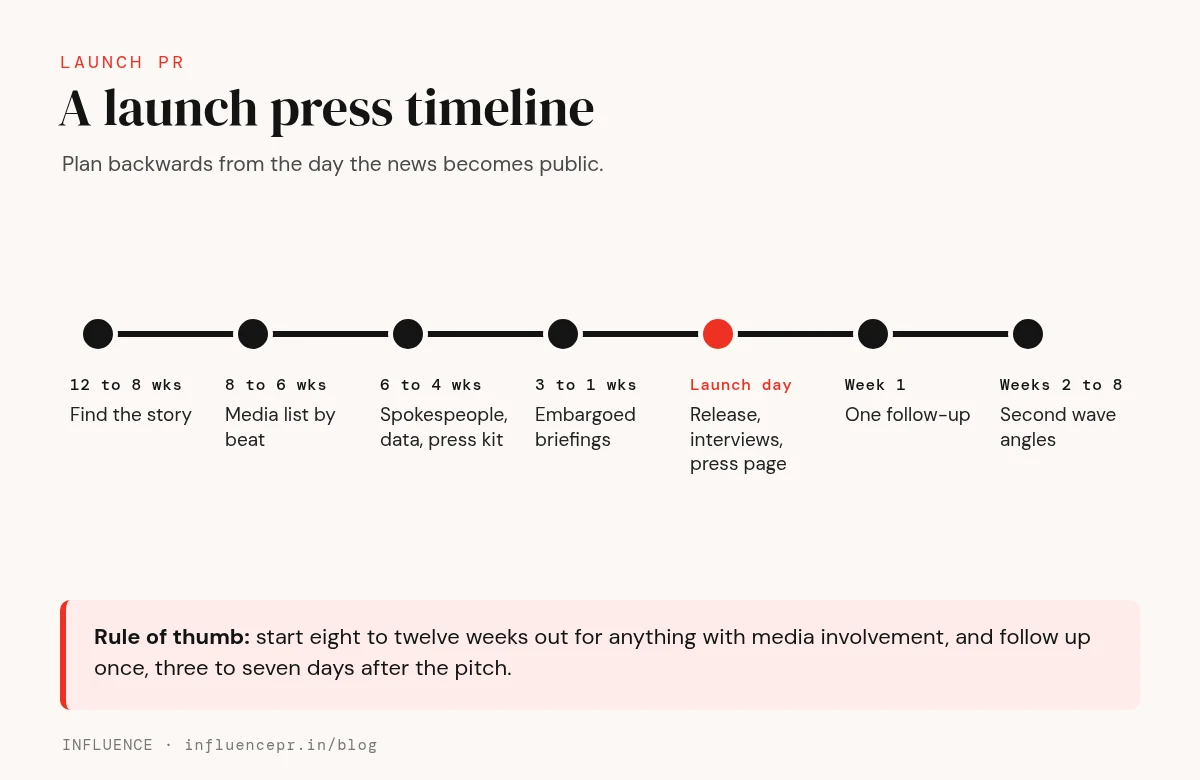
Most product launch checklists cover inventory, pricing and sales readiness, and treat PR as one line near the end. For coverage, plan backwards from the day the news becomes public. This is the timeline we use for launches with media involvement; adjust the weeks to your news, not the other way round.
| When | Press task | Done when |
|---|---|---|
| 12 to 8 weeks out | Find the story; decide what is genuinely new and who it matters to | The news fits in one sentence without the brand name, and a stranger would care |
| 8 to 6 weeks out | Build the media list by beat: national business, trade, regional, digital and creators where relevant | Every name has a recent story on your category |
| 6 to 4 weeks out | Prepare spokespeople, data and the press kit; decide whether an event, a briefing or an exclusive suits the news; if a launch film is part of the plan, lock its versions now (see what a brand film costs in India) | Two spokespeople briefed; facts sheet, images and sources ready |
| 3 to 1 weeks out | Brief priority journalists under embargo; offer one exclusive if the news justifies it | Interviews booked before launch day |
| Launch day | Release goes out; spokespeople available all day; assets live on a press page | Every journalist request answered the same day |
| Week 1 after | One polite follow-up to those who did not reply; share early reactions | No journalist chased more than once |
| Weeks 2 to 8 after | Second wave: early customer data, founder commentary, trade and regional angles | At least one new angle pitched that is not “we launched” |
Two details from the Muck Rack data are worth building into the plan: half of journalists say one follow-up is ideal, and 51% say it should come three to seven days after the pitch (Muck Rack, 2025). One follow-up, not five.
Do we need a launch event to get press?
Not always. An event earns its cost when the news benefits from being seen, tasted or tried in person. For a product refresh, a one-to-one briefing or an embargoed exclusive usually works better than a large room. When an event is right, design it around the coverage moment: where the photograph happens, when the announcement lands and who is free for interviews. In our experience, forty of the right people beat four hundred guests. Our launch PR and launch events practice plans the run of show around press from the start.
Can we still get coverage for a launch that got none?
Yes, but not by pitching the same launch again. The launch is now old news, so find a new reason to talk:
- Early results. After four to eight weeks you may have real numbers: demand by city, repeat orders, a customer behaviour you did not expect. Use only figures you can stand behind.
- A founder point of view. What did building this teach you about the category? Opinion pieces and expert comment travel further than product news. Our guide for founders who are invisible online covers the groundwork.
- Trade and regional press. Trade titles and regional-language outlets often want detail the national business pages do not have room for.
- A bigger story. Offer your spokesperson as a source when journalists cover the trend your product is part of.
Steady media relations between launches makes each of these easier, because the journalists already know who you are. For founder-led companies, press coverage for founders usually starts with the founder’s view, not the product. If you are planning startup PR from scratch, our 90-day PR plan for startups in India sets out the sequence.
When should we stop chasing press?
When the news is not there yet. Some launches matter a great deal to your customers and very little to a journalist. That is fine. Put the effort into channels you control or can earn more easily: your own site and newsletter, the founder’s LinkedIn, creators who already speak to your buyers, and retail or marketplace partners. For D2C and consumer brands, those channels often drive more sales than a single article. Come back to the press when you have something new to say.
If the gap is bigger than one launch (ongoing media relations, not a one-off spike), see Influence public relations for how we run continuous press work with founders and brands. Teams in the capital region can also see how we work on PR in Delhi NCR.
Frequently asked questions
Why did our product launch get no media coverage?
Usually because there was no news a journalist could use, the pitch reached the wrong reporters, it arrived too late, it read like an advert, or nobody and nothing was available for the story. Muck Rack’s 2025 survey found 86% of journalists disregard pitches that are not relevant to their beat.
Is it too late to get press after a launch?
No, but the launch itself is now old news. Plan a second wave four to eight weeks later around something new: early customer data, a founder point of view on the category, a regional or trade angle, or an expert comment on a bigger story journalists are already covering.
How far ahead should we start PR for a product launch?
For anything that needs media, start eight to twelve weeks before launch day. That leaves time to find the story, build a beat-matched media list, prepare spokespeople and assets, and brief journalists under embargo before the news is public.
Do we need a launch event to get press?
Not always. An event helps when the news benefits from being seen or tried in person. For product refreshes, a one-to-one briefing or an embargoed exclusive often works better than a large room. Design any event around the coverage moment, not around the guest list.
Should we pay for coverage if the launch got none?
Paid placements are advertising and should be labelled as such; they do not build the credibility that earned coverage does. Fix the story, the list and the timing first. If you do buy space, treat it as a media plan, not as PR.
Want your next launch to be covered, not just attended? Share the launch date and what is new, and we will map the story, the list and the timeline with you. Book a consultation with Influence.
Related reading
- How to choose a PR firm in India: 12 questions to ask before you sign
- How much does a PR firm cost in India? What drives the quote
- Our founder is invisible online. Where do we start?
Sources
- Muck Rack, The State of Journalism 2025 (survey of journalists, 4 to 30 April 2025; 1,515 responses analysed)
- Cision, How to pitch different media outlets (based on the 2025 State of the Media Report)
- exchange4media, How PR and comms is rewriting the way brands show up during cultural moments (Ritika Upmanyu, 2 November 2026)
4 responses