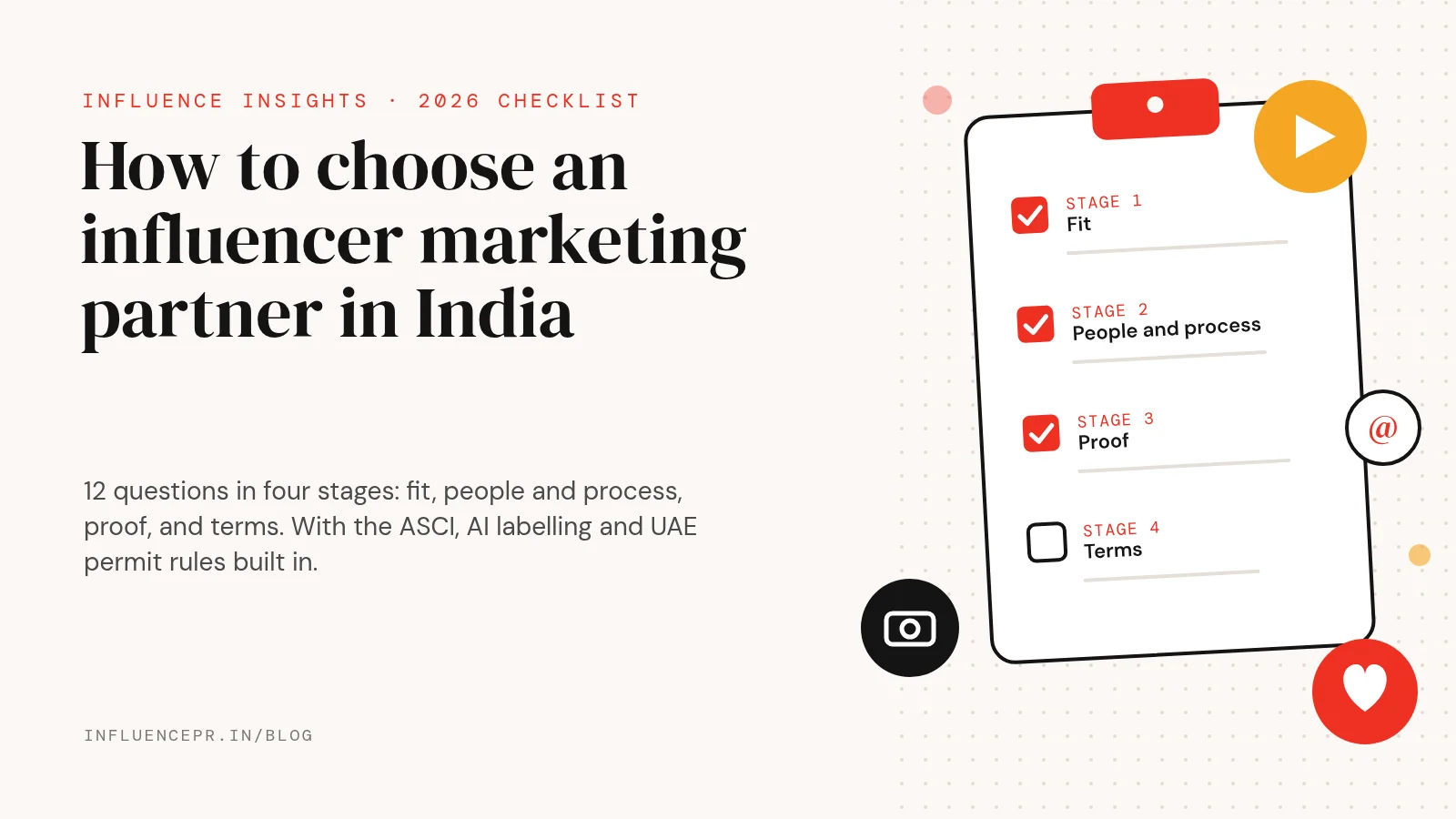
Short answer: To choose an influencer marketing partner in India, shortlist three to five firms and ask each the same 12 questions in four stages: fit with your goal and audience, the people and process behind every post, proof you can click, and written terms on fees, usage rights and exit. Score every answer 0, 1 or 2.
Last updated: 20 October 2026
If you are working out how to choose an influencer marketing partner in India, the pitch decks will look alike: creator grids, reach numbers and a few famous names. What separates a good partner from a risky one is less visible. It is who checks the Ad label at 11pm before a post goes up, who reads the contract clause on usage rights, and whether anyone can tell you what the campaign actually sold. The rules also changed in 2026. ASCI published AI labelling guidelines in September, and the UAE now requires creators to hold an Advertiser Permit. This checklist puts the questions and the rulebook in one place.
What does an influencer marketing partner actually do?
An influencer marketing partner is the outside team that plans, finds, contracts, briefs and measures creators for your brand, and shares the compliance load with you. In practice the work covers strategy and budget split, creator discovery and vetting, negotiation and contracts, briefs and script approvals, disclosure and claim checks, posting schedules, paid amplification where agreed, and reporting.
Some brands use a self-serve platform to find creators and run everything in-house. Others hire a managed partner who does the end-to-end work. Many mix the two. The 12 questions below work for both, because the obligations under ASCI and consumer law sit with your brand whichever route you take. If you want to see what a managed scope looks like, our creator partnerships page sets out the stages we run for brands.
What is the 12-question influencer partner checklist?
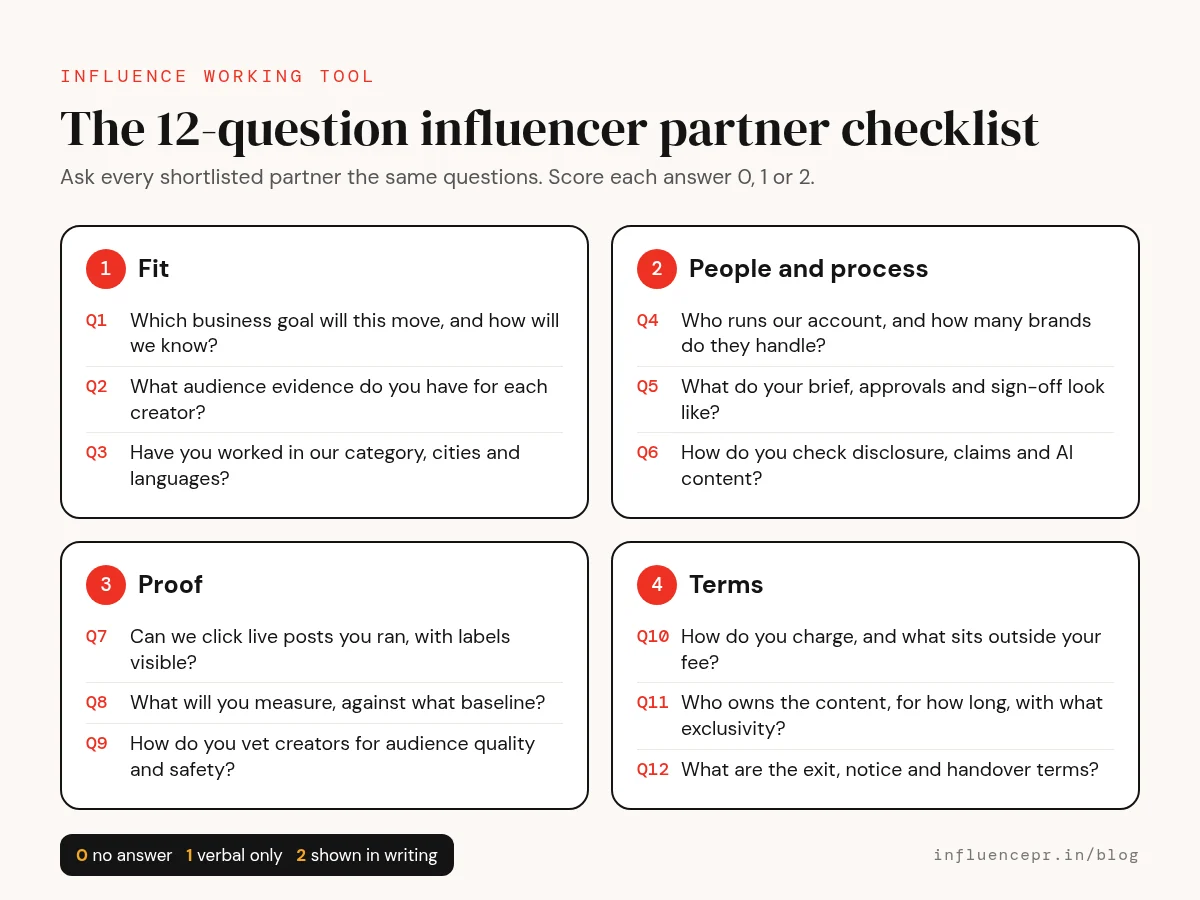
It is the working tool we use at Influence when brands ask us to review a creator programme or a shortlist of partners. It is our own method, not an industry standard, and it mirrors the 12 questions in our guide on how to choose a PR firm in India, so you can use one scoring sheet across PR and creator work. Ask every shortlisted partner the same questions, in writing, and score each answer.
Stage 1: Fit
- Which business goal will this campaign move, and how will we know? A good answer names one main goal, such as awareness in two cities, app sign-ups or marketplace sales, and the number you will watch. A weak answer promises “reach” and “buzz”.
- What audience evidence do you have for each creator? Ask for screenshots from the creator’s own platform insights: city, age band, gender split and language. Follower count alone tells you nothing about whether your customers are watching.
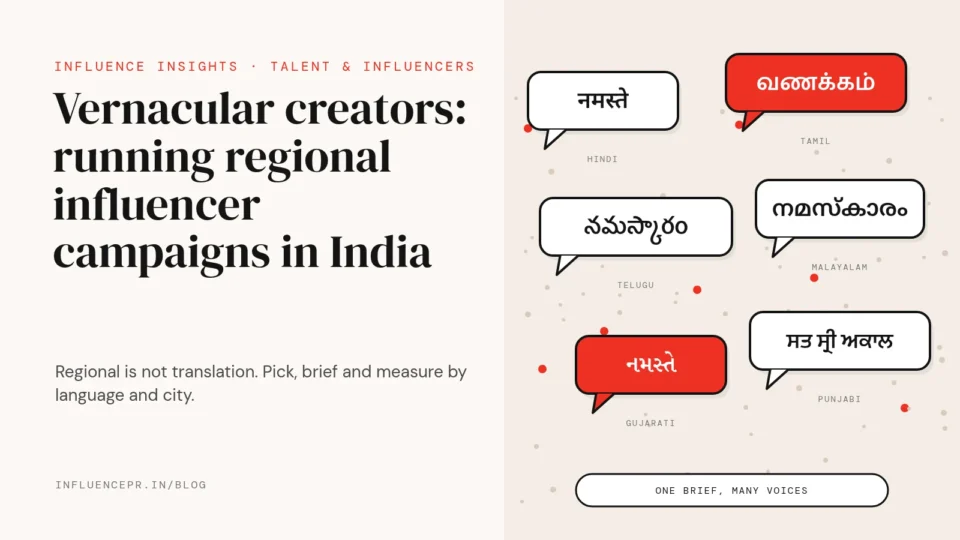
- Have you worked in our category, cities and languages? A partner who has run beauty creators in Mumbai may not know Tamil food creators or finance creators. Ask for examples in your category and your languages, including regional creators; our guide to choosing and briefing vernacular creators shows what that evidence should look like. For seasonal timing, our festive creator marketing guide shows how occasion and region change the plan.
Stage 2: People and process
- Who will run our account, and how many brands does each person handle? Ask for names, roles and the share of their week that is yours. Senior people in the pitch and unnamed juniors in the contract is a common gap.
- What do your brief, approvals and sign-off look like? Ask to see a sample brief: key messages, claims the creator may and may not make, mandatory labels, posting window, number of revision rounds and who approves the final cut.
- How do you check disclosure, claims, qualifications and AI content before anything goes live? This is the question most pitches skip. A good partner has a written pre-post check that covers the ASCI label, any claim that needs evidence, creator qualifications for finance or health topics, and any AI-generated element. Our explainer on ASCI’s AI content labelling rules covers the AI part in detail.
Comparing creator partners right now? Send us the brief and the proposals and we will help you run the 12 questions before you sign. Book a consultation with Influence.
Stage 3: Proof
- Can we click live posts you ran, with the disclosure visible? Case study slides are easy to make. Live links show the real creative, the real comments and whether the label was there.
- What will you measure, against which baseline? Agree the method before money moves: UTM links, discount codes, cost per order, branded search or sign-ups. At an Indian Influencer Governing Council roundtable reported by Social Samosa in October 2026, one participant described tracking creator work through UTMs and cost-per-order models. In ETRetail, Theater’s co-founder said influencer marketing “does not fit neatly into customer acquisition cost calculations”, because people discover a product through a creator and buy days later through another route. That is exactly why the measurement plan has to be written down at the start. Our measurement work shows how we evaluate creator and ambassador deals before renewal.
- How do you vet creators for audience quality and brand safety? Ask what the partner checks: sudden follower jumps, comment quality, past content that clashes with your brand, and recent work for your competitors.
Stage 4: Terms
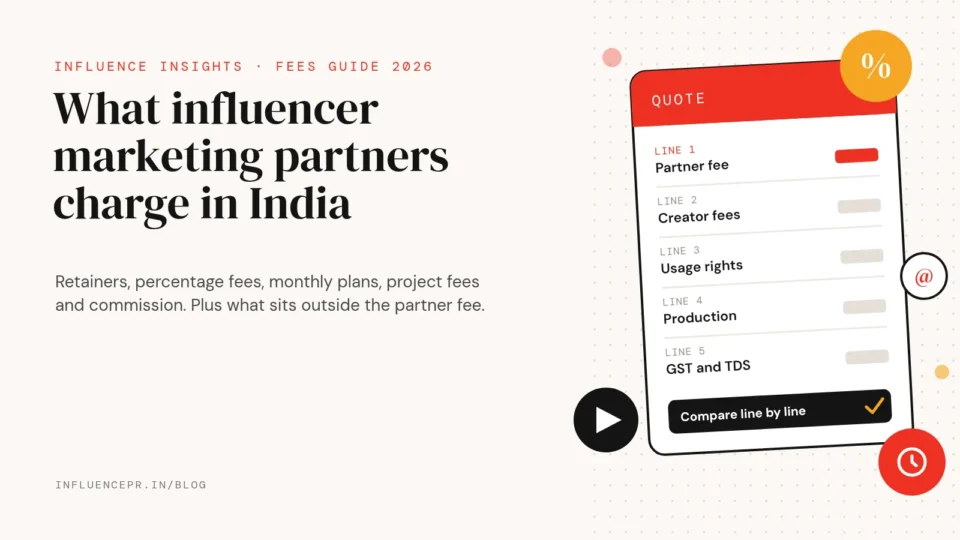
- How do you charge, and what sits outside your fee? Creator fees, paid amplification, production, travel, GST and TDS on gifted products are usually separate lines. See the fee models section below, and our guide to influencer marketing fees in India for a budget method and a line-by-line quote comparison.
- Who owns the content, how long can we use it, and what exclusivity are we paying for? Usage rights for paid ads, whitelisting, duration and category exclusivity should be in writing for each creator. At the same IIGC roundtable, creator Rajiv Makhni said, “Long-term partnerships without exclusivity are an oxymoron,” and participants said the opportunity cost of exclusivity “should be recognised in compensation”. Our deal structuring for talent and creator contracts work covers these clauses.
- What are the exit, notice and handover terms? You should get the creator contracts, contact routes, raw files, performance data and approvals log if you part ways.
Which rules must your partner already follow in India?
Your partner should be able to explain each of these without looking them up. Responsibility is shared: ASCI’s influencer guidelines put disclosure on both the advertiser and the influencer, and say the advertiser shall, where needed, call upon the influencer to delete or edit a post or its label.
| Rule | What it requires | Question to ask your partner |
|---|---|---|
| ASCI Guidelines for Influencer Advertising in Digital Media | Disclose any material connection, including free products “received unsolicited”, discounts, trips and media barters. The label must be “upfront and prominent”, for example Advertisement, Ad, Sponsored, Collaboration, Partnership, Employee, Free gift or Affiliate, or the platform’s paid partnership tag. | Who checks the label on every post, and where is that check recorded? |
| ASCI video and live rules | Videos of 15 seconds or less: label for at least 3 seconds. Up to 2 minutes: one third of the length. Longer: the whole section where the brand appears. Live streams: announce at the start and the end. | How do you check label timing on Reels, Shorts and lives? |
| ASCI virtual influencers | A virtual influencer must also disclose that consumers are not interacting with a real human being. | If we use a virtual or AI creator, where does that disclosure appear? |
| ASCI finance and health qualifications | Stock or investment advice needs SEBI registration, with the number stated. Other financial advice needs suitable qualifications such as an IRDAI licence, CA or CS. Health and nutrition advice needs relevant qualifications, stated upfront. | How do you verify credentials before signing a finance or health creator? |
| ASCI AI labelling guidelines (September 2026) | Labels are mandatory for “synthetically generated influencers and ambassadors”. The guidelines take effect three months from publication (press release, 29 September 2026). | Which assets use AI, and how will each be labelled? |
| Department of Consumer Affairs, Endorsements Know-hows! (January 2023) | Applies to celebrities, influencers and virtual influencers. Disclosures must be prominent and “extremely hard to miss”. Endorsers should not endorse products they have not used or on which they have not done due diligence. | Has each creator used the product, and is that on record? |
| Income-tax Act, section 194R | TDS at 10% on business benefits above Rs 20,000 in a financial year. A product kept by a social media influencer is a benefit; a product returned after use is not. | Who tracks gifted products and TDS: you, the partner or us? |
Tax rules change with each Finance Act, so confirm the current position with your tax adviser before a campaign that gifts products.
Running creators in the UAE too?
Many Indian brands run creators in Dubai and Abu Dhabi alongside India. The UAE Media Council launched the Advertiser Permit in July 2025 for individuals who publish promotional content on social media, “whether their content is paid or unpaid” (WAM). Key points for brands:
- The permit number must be clearly displayed on the creator’s account, and ads may only run through the registered account.
- Visiting creators need a Visitor Advertiser Permit, applied for through a licensed advertising or talent management company authorised in the UAE and approved by the Council. It is valid for three months and renewable once.
- The Council called on companies “to engage only with individuals licenced by the council” (corroborated by The National).
- The permit is free for the first three years. What’s On Dubai reported in January 2026 that it costs Dhs1,000 a year from the fourth year and that a visitor permit costs Dhs500 for three months. We could not open the Council’s own fee page when this was written, so confirm fees with the Council.
Ask your partner for each UAE creator’s permit number before contracting. If the UAE is a new market for you, our UAE market entry work covers the wider launch plan, and our checklist on choosing a PR firm in Dubai as an Indian brand covers the permit questions to put to any firm.
How do influencer marketing partners charge in India?
There is no official rate card, and we do not publish invented fee bands. What you can compare is the fee model. Most partners use one of these, or a mix:
| Fee model | How it works | Suits | Watch for |
|---|---|---|---|
| Monthly retainer | Fixed monthly fee for an agreed scope of planning, creator management and reporting | Always-on creator programmes | Scope with no deliverable count or named team |
| Percentage of spend with a minimum | Fee is a share of the creator or media budget, with a floor. One Noida firm publishes its own fee as “Rs 75,000 or 10% of media management, whichever is higher, plus applicable taxes”, with creator pay and paid media outside it. That is one firm’s published model, not a market rate. | Campaigns where budget size changes month to month | An incentive to grow spend rather than results |
| Project fee | One fee for a defined campaign, such as a launch or a festive burst | Clear start and end dates | Extra rounds and add-ons billed after kickoff |
| Commission or affiliate | Creators, and sometimes the partner, earn a share of sales they drive. Marketplaces use this too: Storyboard18 reported in October 2026 that Myntra is “increasing creator commissions by three times” for the festive period. | Ecommerce and D2C brands with clean tracking | Attribution rules and returns policy left unwritten |
| Performance (for example cost per order) | Payment tied to tracked outcomes such as orders or sign-ups | Lower-funnel campaigns on marketplaces or apps | Disputes over which sale counts |
Whatever the model, ask for creator fees, paid amplification, production, GST and TDS as separate lines. The logic is the same as in our guide to what drives PR firm cost: price follows scope, people and extras, so compare quotes line by line rather than by one headline number.
How do you score the answers?
Score each of the 12 answers 0, 1 or 2:
- 0: no answer, or a vague promise.
- 1: a credible verbal answer with nothing written down.
- 2: shown in writing: a sample brief, a live link, a named person, a contract clause or a report.
The maximum is 24. Compare totals, but treat these as deal breakers whatever the score:
- No written disclosure and claim check (Q6).
- No named people on the account (Q4).
- Usage rights and exclusivity left undefined (Q11).
- Proof you cannot click or verify (Q7).
The checklist on one page
Fit
- Which business goal will this move, and how will we know?
- What audience evidence do you have for each creator?
- Have you worked in our category, cities and languages?
People and process
- Who runs our account, and how many brands do they handle?
- What do your brief, approvals and sign-off look like?
- How do you check disclosure, claims, qualifications and AI content?
Proof
- Can we click live posts you ran, with labels visible?
- What will you measure, against which baseline?
- How do you vet creators for audience quality and brand safety?
Terms
- How do you charge, and what sits outside your fee?
- Who owns the content, for how long, with what exclusivity?
- What are the exit, notice and handover terms?
How does Influence approach creator partnerships?
Influence is a PR and integrated marketing consulting firm. We plan creator and celebrity work from the business outcome first, through our creator partnerships practice and SIGND by Influence, our influencer and celebrity marketing platform, where brands partner with celebrities and creators from different disciplines. Contracts, usage rights and exclusivity run through our deal structuring team. We will answer all 12 questions in writing before we talk about a fee.
Frequently asked questions
How many influencer marketing partners should we shortlist?
Three to five is usually enough. Send each one the same written brief and ask all 12 questions so you can compare the answers side by side. A longer list turns selection into a pitch contest that rewards presentation over process.
Who is responsible if a creator skips the Ad label?
Under ASCI’s influencer guidelines both the advertiser and the influencer are responsible for disclosure, and the advertiser may call on the influencer to edit or delete the post. Your partner should check every label before it goes live and keep a record of the checks.
Do gifted products need a disclosure and TDS?
ASCI counts free products, including those received unsolicited, as a material connection that must be disclosed. The Income Tax Department says a product a social media influencer keeps is a benefit that attracts TDS under section 194R, while a product returned after use is not. Check the current rule with your tax adviser.
Can we use AI or virtual influencers in India?
Yes, with labels. ASCI requires virtual influencers to disclose that consumers are not interacting with a real human being, and its September 2026 AI labelling guidelines make labels mandatory for synthetically generated influencers and ambassadors.
Do creators in Dubai and the rest of the UAE need a permit?
Yes. The UAE Media Council’s Advertiser Permit covers individuals who publish promotional content, paid or unpaid. Visiting creators need a Visitor Advertiser Permit through a licensed, Council-approved advertising or talent management company in the UAE. Ask for the permit number before you contract anyone.
Want a second opinion on your creator shortlist? Tell us the goal and the partners you are considering, and we will help you score them. Book a consultation with Influence.
Related reading
- ASCI’s AI content labelling rules (Sept 2026): what brands and creators must change
- How to choose a PR firm in India: 12 questions to ask before you sign
- Festive creator marketing in India 2026: where the Rs 900 crore goes and how to plan yours
Sources
- ASCI, Guidelines for Influencer Advertising in Digital Media (incl. addendum on qualifications)
- ASCI, Guidelines for Responsible Labelling of Synthetically Generated Content in Advertising (September 2026)
- ASCI press release, 29 September 2026
- PIB, Department of Consumer Affairs releases Endorsements Know-hows! (20 January 2023)
- Income Tax Department, TDS on benefit or perquisite arising from business or profession (section 194R)
- WAM, UAE Media Council launches Advertiser Permit (30 July 2025)
- The National, UAE social media advertiser permit (30 July 2025)
- What’s On Dubai, How to get the UAE Advertiser Permit (21 January 2026)
- Social Samosa, Where creator-brand partnerships fall short: IIGC roundtable (October 2026)
- ETRetail, Festive marketing faces an ROI test as brands shift towards creators (16 October 2026)
- Storyboard18, Myntra triples creator commissions (9 October 2026)
- Digistreet Media, guide to choosing an influencer marketing partner (9 October 2026)
See how we plan and run influencer marketing in India and the UAE.
4 responses
Responses are closed for this insight.