Short answer: To run a regional influencer campaign in India, start from the language and city markets where you sell, pick creators by language, locality, lived context and proven engagement rather than follower count, brief them to co-create in their own idiom, disclose in a language the audience reads, and measure each creator against peers in the same market.
Last updated: 10 November 2026
Regional influencer marketing is a brand’s paid or gifted work with creators who speak to a specific language or local audience, built so the creator co-creates the message in their own idiom rather than translating a national campaign.
Most Indian brands now know that audiences outside the metros matter. Fewer know how to run a campaign there without it turning into a national script dubbed into six languages. This guide is the brand-side playbook: what the 2026 data says, where the data disagrees, when a regional roster beats one national face, how to choose and brief vernacular creators, what India’s disclosure rules mean in a regional language, and how to measure the result honestly.
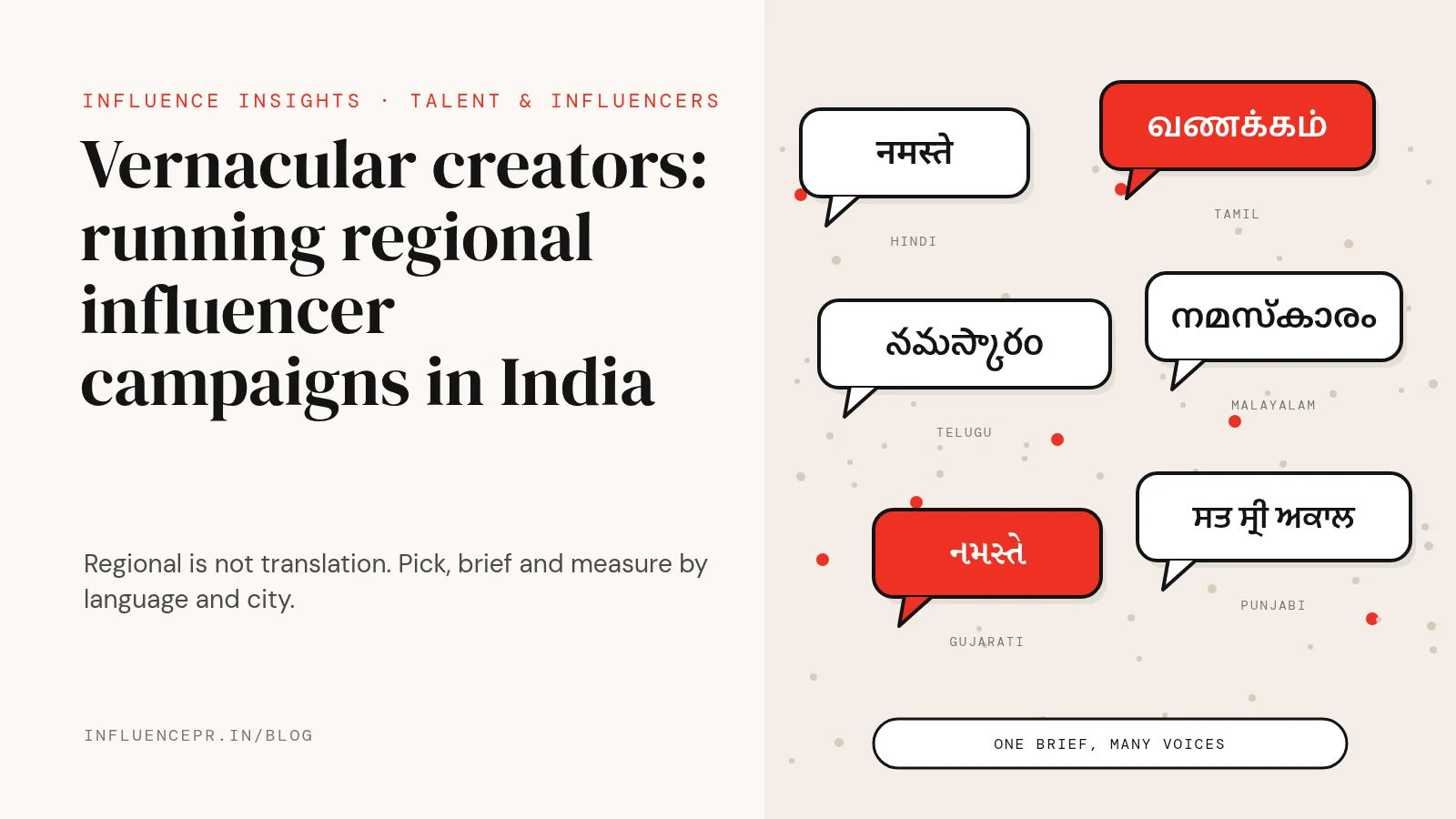
Why are brands moving influencer budgets to regional creators?
Because the audience, the creators and the engagement have moved, and the 2026 data from several sources points the same way:
- Campaigns are already outside the metros. Kofluence’s Decoding Influence 2026 report says Tier 3 and 4 cities now account for 43 to 48% of all influencer campaigns, with engagement of 4.5 to 5.5% against 3 to 4% in metros (BuzzInContent, 14 May 2026).
- Brands are asking for vernacular content. In the same report, more than 62% of creators said brands are asking them for more vernacular or regional-language content (BuzzInContent).
- Creator supply has grown fastest outside the metros. Data from the Indian School of Business (ISB) and creator platform Hashfame, reported by exchange4media, counts about 4.12 million Indian creators in 2025, up from 0.96 million in 2020. Non-metro creator supply grew 6.4 times over that period, against 2.6 times in metros, and non-metro creators are now 66% of the creator base (exchange4media, 17 July 2026).
- Brand searches are following. Reelax, a creator platform, reports from over 40,000 brand-creator collaborations on its own platform that creator discovery searches from outside metro India overtook metro searches for the first time in March 2026, and that Kannada, Marathi and Odia creator discovery grew faster than Hindi and English (Reelax Creator Economy Report H1 2026). Treat this as one platform’s data, not the whole market.
- Communications teams see the same shift. PRCAI’s SPRINT 2026 survey with Ipsos found regional PR’s share of industry revenue rose from 10% three years ago to 19% in 2026, 65% of corporate communicators name Tier 2 cities as the primary growth engine, and influencer marketing’s revenue share doubled from 8% to 16% (Ipsos, 5 July 2026).
There is a catch in the same data. ISB and Hashfame found that around 85% of non-metro creators complete no brand campaign in a year, and only 2.1% complete five or more (exchange4media). Supply is not the problem. Brands that know how to find, brief and pay these creators are.
Is regional India Hindi-led or not? The data disagrees
Read the reports side by side and they seem to contradict each other on language:
| Source | What it measured | What it found |
|---|---|---|
| Kofluence, Decoding Influence 2026 | Creators surveyed for the report (primary language) | Hindi is the primary language for 68.2% of creators; 23.9% create in regional languages (BuzzInContent) |
| ISB and Hashfame | India’s creator base | Regional-language creators are 58% of the base and Hindi creators 42% (exchange4media) |
| Reelax H1 2026 | Creator discovery searches on one platform | Kannada, Marathi and Odia discovery grew faster than Hindi and English (Reelax) |
These are different samples measuring different things: who answered a survey, who exists in a creator database, and what brands searched for on one platform. None of them is wrong, and none of them tells you about your customers. The practical lesson is to check the language mix of your own buyers and your own social audience by state before you decide between a Hindi-first plan and a multi-language one. Do not let a national headline make that decision for you.
Regional creators or one national face?
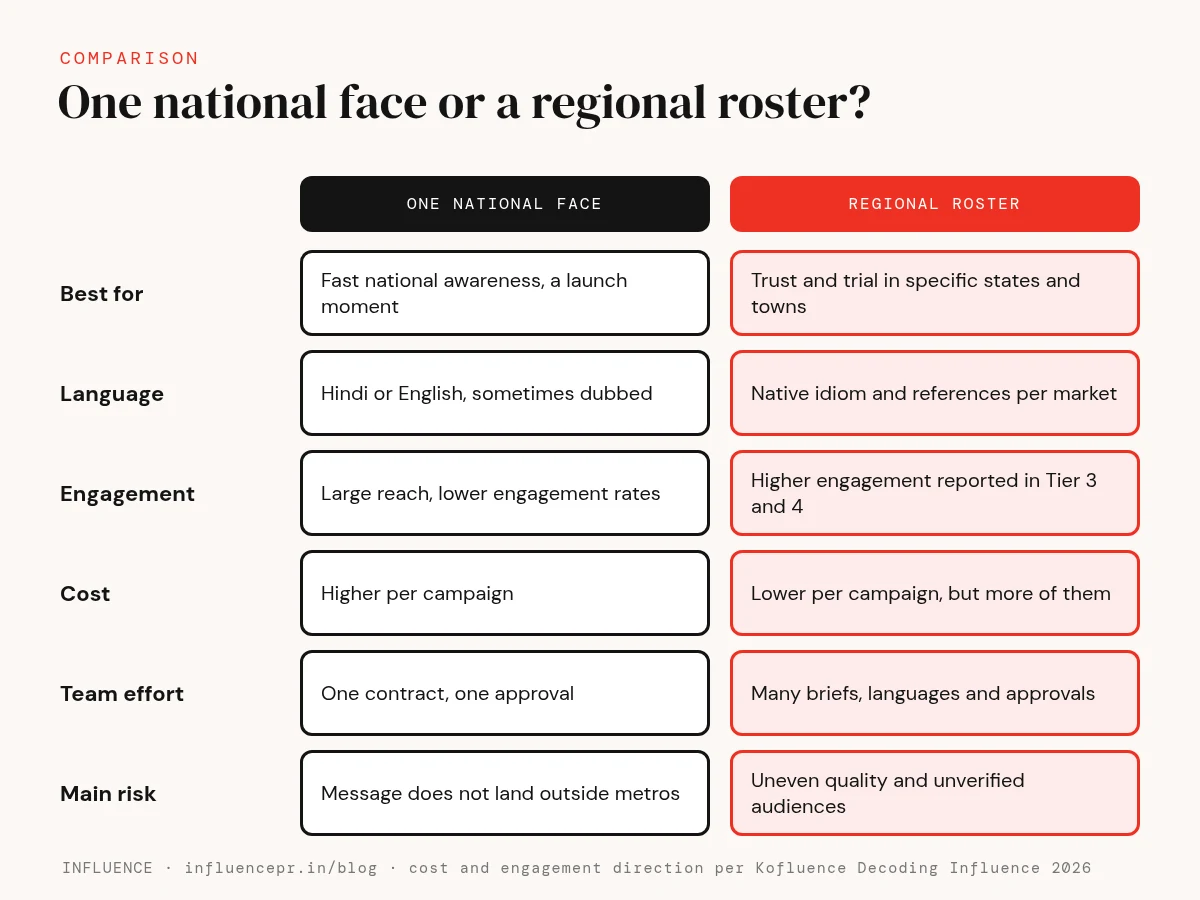
Regional creators are not automatically better. They solve a specific problem: being understood and trusted in a particular language market. Use this comparison to decide what your campaign needs.
| One national face (celebrity or metro macro creator) | A roster of regional creators | |
|---|---|---|
| Best for | Fast national awareness, a launch moment, a premium or aspirational position | Trial, consideration and trust in specific states, languages and towns |
| Language and context | Usually Hindi or English, sometimes dubbed | Native idiom, humour and references for each market |
| Engagement | Large reach; Kofluence reports lower engagement in metros (3 to 4%) | Higher engagement reported for Tier 3 and 4 markets (4.5 to 5.5% vs 3 to 4% in metros, per Kofluence) |
| Cost per campaign | Higher; Kofluence reports metro campaign averages of Rs 3.8 lakh to 4.5 lakh | Lower per campaign; Kofluence reports Rs 35,000 to 90,000 for Tier 3 and 4 markets, but you run more of them |
| Work for your team | One contract, one approval chain | Many contracts, briefs, languages and approvals to manage |
| Main risk | One message that does not land outside metros | Inconsistent quality, unverified audiences and weak disclosure across many creators |
Many brands end up with both: a national face for the moment and regional creators for depth. If you are weighing a celebrity against creators, see our guide to choosing between a celebrity and creators. For festive campaigns specifically, our festive creator marketing guide covers timing and spend.
How do you pick regional creators? The 4L check
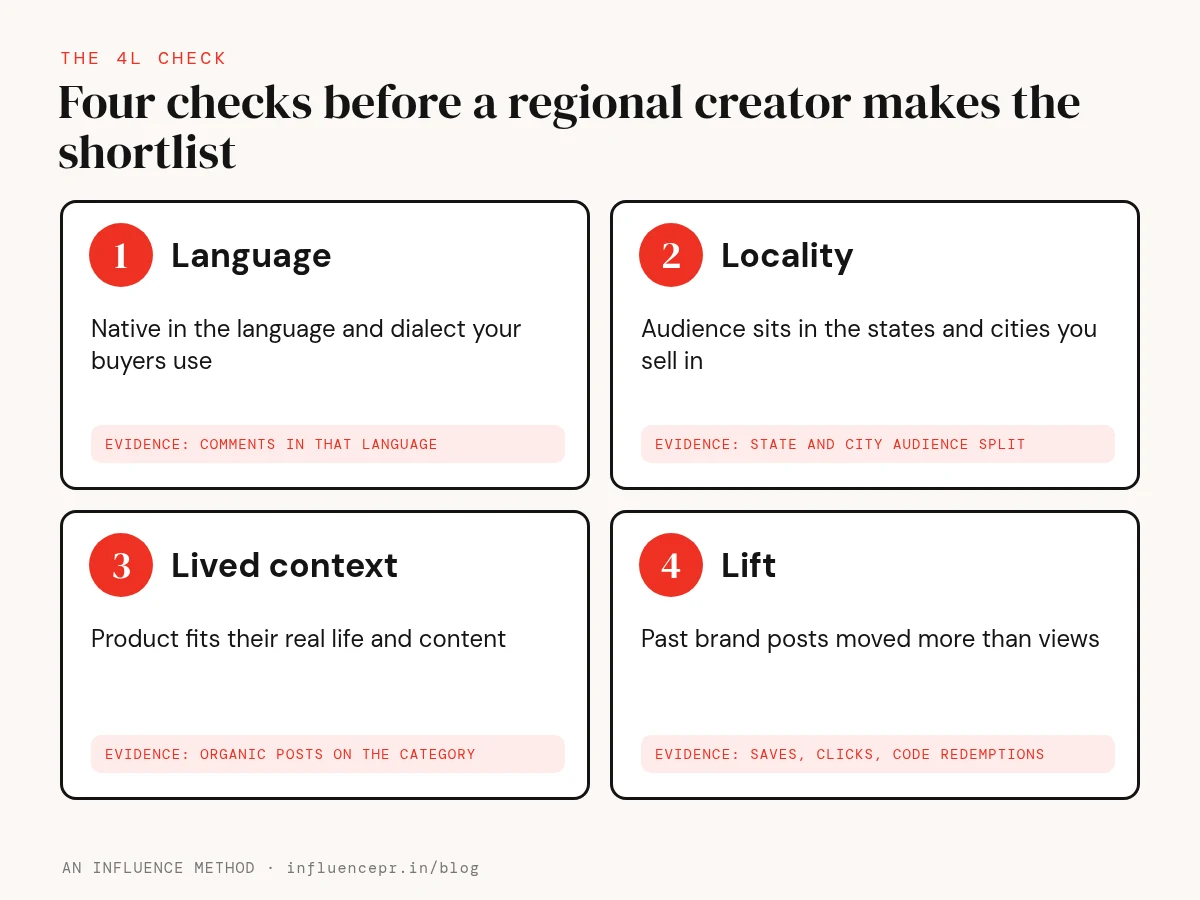
Follower count is the weakest signal in regional work. We use a four-part check at Influence, which we call the 4L check: Language, Locality, Lived context and Lift. A creator should pass all four before they make a shortlist.
| Check | The question | Evidence to ask for | Red flag |
|---|---|---|---|
| 1. Language | Do they create natively in the language your buyers use, including the dialect and the mix with English or Hindi? | Their last 20 posts; comments written in that language | Content in one language, comments mostly in another or in generic emojis |
| 2. Locality | Is their audience actually in the states and cities where you sell or distribute? | Audience location split by state and city from platform insights, shared as a screenshot | Audience concentrated outside India or outside your distribution footprint |
| 3. Lived context | Does the product fit their real life and content, so the audience will believe them? | Past content on the category; how they talk about money, family, food or work | A run of unrelated paid posts with no organic content about the category |
| 4. Lift | Have their past brand posts moved anything beyond views? | Results from two or three previous brand posts: saves, shares, clicks, code redemptions | Only reach and views offered; no previous brand work they can show |
Check authenticity before you check anything else. Reelax says its audit data shows roughly one in four profiles pitched to brands fails a basic audience-authenticity screen (Reelax), and 98% of respondents in PRCAI’s SPRINT 2026 survey want greater verification and regulation of influencer content (Ipsos). Ask for platform insights directly from the creator, and compare engagement with peers in the same language and city, not with English creators in Mumbai. For a wider set of questions to ask any partner who builds the shortlist for you, use our influencer marketing partner checklist.
Planning your first campaign outside the metros? Tell us which states and languages matter to your sales, and we will show you, in one call, how we would shortlist, brief and measure creators for them. Book a consultation with Influence.
How do you brief a regional creator: co-creation, not translation
The most common mistake is to write one national script and ask creators to translate it. Neha Markanda, Chief Business Officer of ShareChat and Moj, put it directly: “Brands that treat them as translation partners are missing the point. The ones that co-create with them are the ones winning regional India” (exchange4media). Kofluence’s report makes the same point, that vernacular content is not only about translation and that regional audiences respond to creators who speak in familiar idioms and reflect local realities (BuzzInContent).
A brief that leaves room for co-creation has these parts:
- The one thing to land. A single message or product truth, in plain words, that every creator must get across.
- The fixed facts. Price, offer, claims you can prove, and anything legal or regulated. These do not change by language.
- What the creator owns. Format, story, humour, setting and wording are theirs. Say so in the brief.
- Local hooks they can use. Festivals, cricket, exams or harvest seasons that matter in their market. Ask them to suggest the hook rather than assigning one.
- Words to avoid. Claims you cannot support and competitor references, translated and checked by a native speaker.
- Disclosure. The exact label, the language it will appear in and where it goes (see the next section).
- Approvals. One concept review and one final review, with a native speaker on your side for each language, and a deadline for both.
- What you will measure. Tell the creator which metrics you will look at, so they can plan for saves or clicks rather than views alone.
Budget the time this takes. A brief for six languages is six conversations, not one email.
What do India’s disclosure rules mean in a regional language?
The Advertising Standards Council of India (ASCI) influencer guidelines apply whatever language the post is in. Three points matter most for regional campaigns (ASCI Guidelines for Influencer Advertising in Digital Media):
- Language of the label. The disclosure should be in English or in the language of the advertisement itself, in a way that is easy for the average consumer to understand. Permitted labels include Advertisement, Ad, Sponsored, Collaboration, Partnership, Employee, Free gift and Affiliate, plus the platforms’ own paid partnership tags.
- Placement and duration. Disclosure must be upfront and prominent, not in the bio, after a “more” click or buried in hashtags. On videos of 15 seconds or less the label must stay for at least 3 seconds; on videos between 15 seconds and 2 minutes, for a third of the length; on longer videos, for the whole section where the brand appears. For audio, it must be announced at the start and end and around every break, which matters for regional audio and live formats.
- Who is responsible. Responsibility sits with both the advertiser and the influencer. The brand must ensure the post follows the ASCI code and can ask the creator to edit or delete it.
In practice, put the exact label and its language into every contract and brief, and check it in each language at the final review. If your campaign uses AI-generated or AI-edited content, ASCI’s separate labelling rules apply too; see our guide to ASCI’s AI content labelling rules.
How should you pay and contract regional creators?
Formal contracts are becoming normal. Kofluence reports that 37.7% of brands route influencer contracts through legal review, and that 76.6% now favour long-term creator partnerships (Kofluence, Decoding Influence 2026). Given that most non-metro creators do few or no brand campaigns a year, many will be new to formal paperwork, so make it easy to say yes:
- Write the key terms in plain language, and offer a translated summary alongside the legal English contract.
- Agree deliverables, dates, usage rights and exclusivity in one table, so there is nothing to argue about later.
- Pay on a stated schedule, with a part on signing for creators who are new to brand work. Slow payment is a quick way to lose good regional creators.
- Prefer a series to a one-off. Several posts over a few months give the audience time to trust the recommendation and give you enough data to judge the creator.
We do not publish creator rate cards, because fees vary widely by language, category and format. For how fees are structured and what sits outside the fee, read our guide to what influencer marketing partners charge in India.
How do you measure a regional influencer campaign?
Only 13.3% of brands directly link influencer marketing to formal revenue targets, according to Kofluence (Kofluence). Regional campaigns are harder still, because a lot of buying happens offline. Set up measurement before the first post goes live:
| What to track | What it tells you | The honest limit |
|---|---|---|
| Engagement rate, compared with peers in the same language and city | Whether the content landed with that audience | Engagement is not sales; compare like with like |
| Comments in the language: questions about price, availability, where to buy | Purchase intent, in the audience’s own words | Needs a native speaker to read and tag |
| Unique links or codes per creator | Attributable online sales and sign-ups by creator | Undercounts people who buy later or offline |
| Branded search and sales by state, before and after | Whether the market moved | Directional only; other marketing and seasons interfere |
| Distributor, retailer or store feedback in target towns | Offline demand the links miss | Anecdotal unless you collect it the same way each time |
| Cost per engaged viewer, by language | Which markets and creators are worth scaling | Only as good as the engagement data behind it |
Judge each creator against others in the same market, keep the creators who moved the metrics that matter, and drop the rest before the next round. Our talent and ambassador measurement work starts the same way: a baseline before launch, and cost per outcome rather than cost per impression.
Mistakes to avoid
- Dubbing a national ad and calling it regional. The audience can tell, and so can the creator’s comments. If a brand film will run in several languages, budget the regional versions from the start; our guide to brand film costs in India lists them as a separate line.
- Choosing by follower count. Run the 4L check first.
- Skipping the native-speaker review. A claim that is fine in English can mean something else in Marathi or Tamil.
- Disclosing in the wrong language or place. A label the audience cannot read, or one hidden in hashtags, does not meet ASCI’s test.
- Benchmarking against metro English creators. It undervalues good regional creators and hides weak ones.
- One-off posts with no follow-through. Trust in smaller markets builds over several posts, not one.
How Influence works with regional creators
Influence is a PR and integrated marketing consulting firm with offices in Gurugram, Greater Noida West and Dubai. For brands, our creator partnerships practice runs creator programmes in four stages: cohort design with audience verification, rates and contracts with disclosure terms, briefs that leave room for creator voice, and measurement with cohort refresh. Every engagement is built to comply with the ASCI influencer guidelines. SIGND by Influence is our talent management and celebrity marketing venture, for brands that need a national face alongside regional creators. On the creator side, our regional creators practice works with Tamil, Telugu, Marathi, Bengali, Punjabi and other language creators on rate benchmarking and national brand access.
Frequently asked questions
What is regional influencer marketing?
Regional influencer marketing is paid or gifted work with creators who speak to a specific language or local audience, such as Tamil, Marathi or Odia viewers, instead of one national audience. It works best when the creator co-creates the idea in their own language and context, rather than translating a national script.
Are regional influencers cheaper than metro influencers?
Often, per campaign. Kofluence’s Decoding Influence 2026 report, as reported by BuzzInContent, puts average campaign costs in Tier 3 and 4 markets at Rs 35,000 to 90,000, against Rs 3.8 lakh to 4.5 lakh in metros. Cheaper is not the goal, though. Compare cost per engaged viewer in the language you need, and budget for more creators, more briefs and more checks.
Which language should an influencer ad disclosure be in?
Under ASCI’s influencer guidelines, the disclosure should be in English or in the same language as the advertisement, in a way the average consumer can easily understand. It must be upfront and prominent, not buried in hashtags or the bio. For a Tamil reel, a clear Tamil or English label at the start works; a label in a language the audience does not read does not.
How many regional creators should a brand start with?
There is no reliable benchmark, so start from your markets, not a number. Pick one or two language markets where you already sell or plan to, build a small roster per market so you can compare creators against each other, and expand only after you can see which language, city and content format moved the metrics you care about.
How do you measure ROI on a regional influencer campaign?
Measure each creator against others in the same language and city, not against metro English benchmarks. Track engagement and comment quality, unique links or codes per creator, and branded search or sales by state where you can. Be honest about the limit: offline and word-of-mouth sales in smaller towns are hard to attribute, so treat search and store signals as directional.
Want a regional creator plan you can defend to your CFO? Share your product, markets and budget range, and we will come back with a language-by-language approach and an honest view of what you can and cannot measure. Book a consultation with Influence.
Related reading
- How to choose an influencer marketing partner in India: a 2026 checklist
- What influencer marketing partners charge in India: retainers, commissions and project fees
- Festive creator marketing in India 2026: where the Rs 900 crore goes and how to plan yours
Sources
- BuzzInContent Bureau, Tier 3 and 4 cities account for up to 48% of influencer campaigns: Report (Kofluence, Decoding Influence 2026), BuzzInContent (14 May 2026)
- Kofluence, Decoding Influence 2026: India influencer marketing report (report page)
- Shalinee Mishra, How regional creators are reshaping India’s influencer economy (ISB and Hashfame data), exchange4media (17 July 2026)
- Reelax, Creator Economy Report H1 2026: key findings (platform data)
- Ipsos and PRCAI, Indian Public Relations market to reach Rs 4,500 crore by 2030: PRCAI SPRINT 2026 (5 July 2026)
- Advertising Standards Council of India, Guidelines for Influencer Advertising in Digital Media (PDF)
4 responses