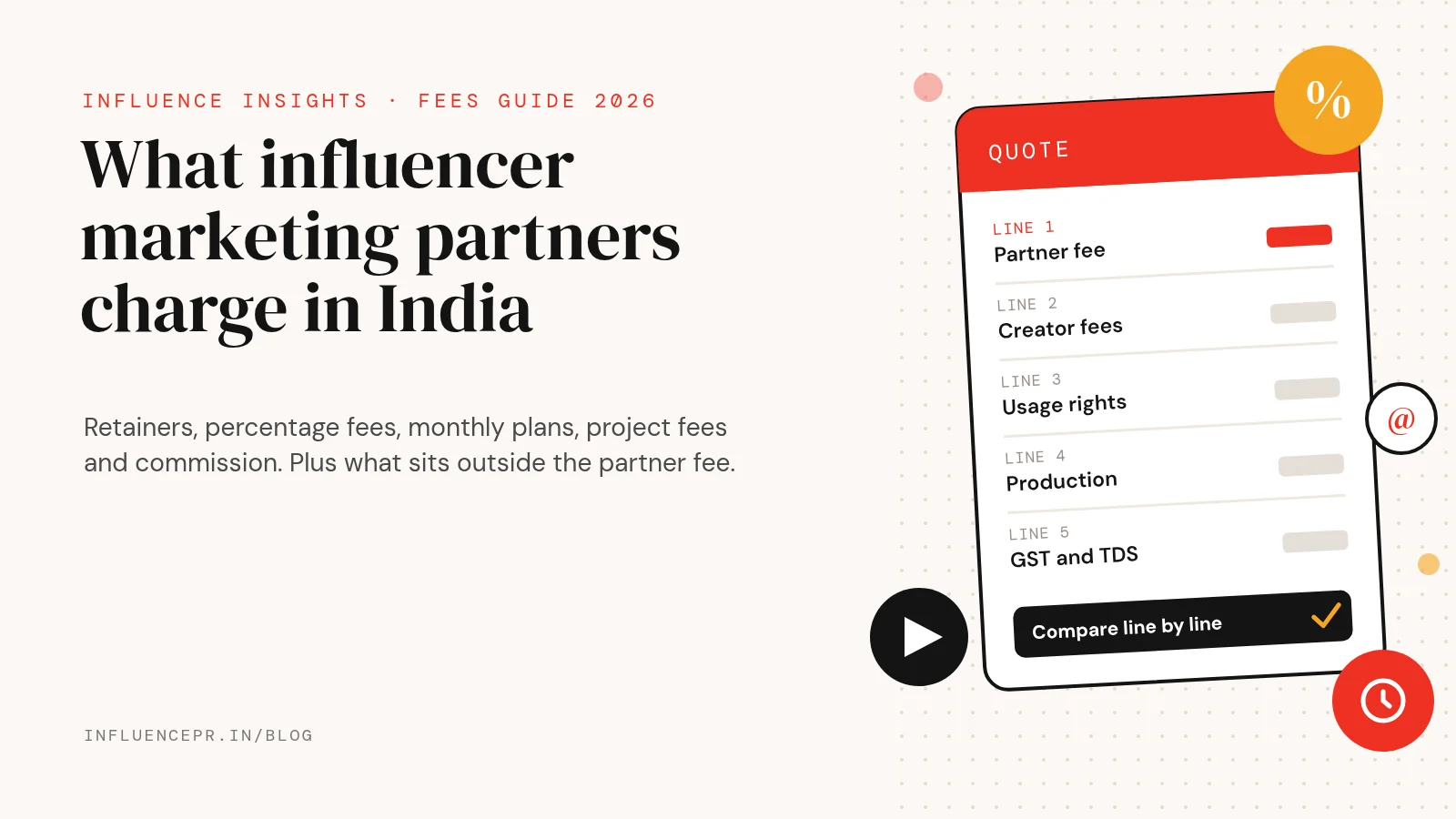
Short answer: Influencer marketing partners in India charge through a monthly retainer, a percentage of spend with a minimum, a fixed monthly plan, a project fee, or commission and performance fees. Creator fees, usage rights, production, paid media, GST and TDS usually sit outside that fee. With no independent benchmark, compare scope and models, not headline numbers.
Last updated: 1 November 2026
Search for influencer marketing partner fees in India and you will find confident rate cards. Very few say where the numbers come from. This guide does it differently. We only quote fees that a firm publishes for itself, we explain what sits outside the partner fee, and we show you how to build a budget and compare quotes line by line. If you are still picking who to shortlist, start with our 12-question influencer partner checklist; question 10 is about fees.
What is an influencer marketing fee?
An influencer marketing fee is what you pay a partner to plan, contract, manage and report on creator work, separate from what the creators themselves are paid. The fee buys people and process: strategy, creator discovery and vetting, negotiation, briefs and approvals, disclosure checks, scheduling and reporting. The creator payouts, and several other costs, are a different line.
Is there a reliable price list for influencer marketing partners in India?
No. There is no official tariff and no independent survey of partner fees. One comparison site, InfluencerMetric, says it found no independent survey of fees in India, only firms publishing their own ranges and price lists. Ranges you see on firm blogs are those firms’ own claims about the market, and they rarely say what scope sits behind the number. We will not repeat them here. The only figures in this guide are fees that a firm publishes for itself, quoted as that firm’s fee, not as a market rate.
What are the main fee models?
| Fee model | How it is billed | A published example | Suits | Watch for |
|---|---|---|---|---|
| Monthly retainer | Fixed monthly fee for an agreed scope | None we could verify as a firm’s own figure | Always-on programmes with steady creator activity | No deliverable count, no named team |
| Percentage of spend with a minimum | A share of the creator or media budget, with a floor | DigiStreet Media publishes its fee as Rs 75,000 or 10% of media management, whichever is higher, plus GST | Budgets that change month to month | An incentive to grow spend rather than results |
| Fixed monthly plan (package) | Set monthly tiers by platform and number of creators | None we could verify | Smaller brands that want a predictable bill | Tier limits on creators, revisions and reporting |
| Project fee | One fee for a defined campaign, such as a launch or festive burst | None we could verify | Clear start and end dates | Extra rounds and add-ons billed after kickoff |
| Commission, affiliate or performance | A share of tracked sales, or a payment per order or sign-up | Myntra is “increasing creator commissions by three times” for the 2026 festive period (Storyboard18) | Ecommerce and D2C with clean tracking | Attribution rules, returns and cancellations left unwritten |
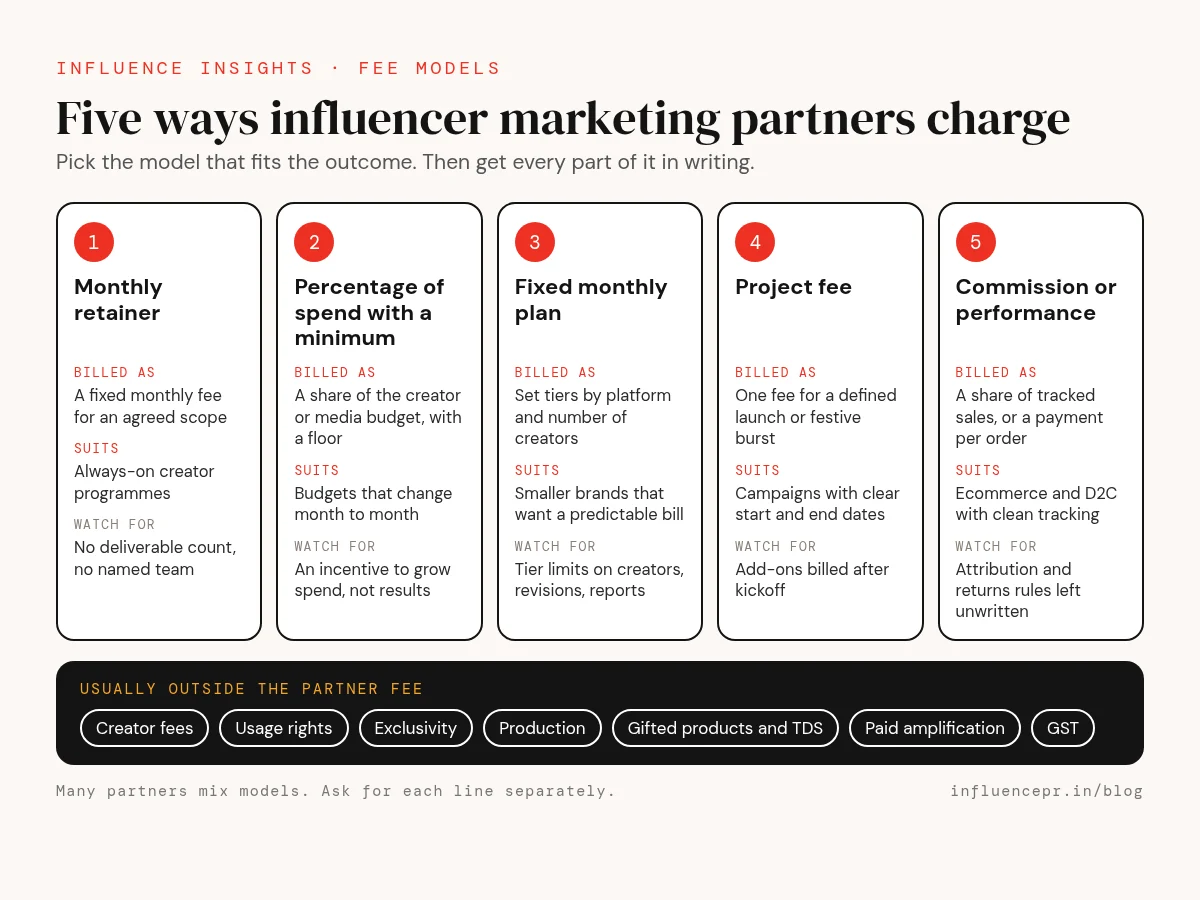
Many partners mix models, for example a small retainer plus a performance bonus. That is fine if every part is written down with what it covers.
What fees have actually been published? A sourced fee table
Every figure below is either a firm’s own published price or a figure attributed to a named person in a named publication. None of them is an independent market survey, so read each one as a reference point, not a rate card.
| Cost line | Published figure | Who says so | How to read it |
|---|---|---|---|
| Partner management fee | Rs 75,000 or 10% of media management, whichever is higher, plus GST | DigiStreet Media, its own fee (6 Oct 2026) | One firm’s price, not a market rate |
| Primary partner’s share of the campaign budget | 10 to 15% | Kiran Shah, founder of Go Zero, quoted in ETBrandEquity (21 Oct 2026) | One brand founder’s experience; extra intermediaries can sit on top |
| Share lost to the chain between brand and creator | “If a brand invests Rs 100 for a creator campaign, the creator may receive only Rs 40” | Nitin Joshi, co-founder of Open Grey, in ETBrandEquity | An estimate for some campaigns, not an average |
| Nano creator fee | Rs 10,000 to Rs 15,000 per deliverable | DigiStreet Media, published cost bands (6 Oct 2026) | Creator fee, paid on top of the partner fee |
| Micro creator fee | Rs 30,000 to Rs 1,00,000 per deliverable | DigiStreet Media, as above | Varies with format, production and rights |
| Macro or celebrity creator fee | Rs 1,00,000 to Rs 25,00,000 per deliverable | DigiStreet Media, as above | The widest band; usage and exclusivity move it most |
| Creator payment cycle | “the usually stated 30-to-90-day cycles” | ETBrandEquity, reporting on Opraah’s OPay | Payment terms are a cost to creators and a risk to you |
| TDS on gifted products kept by the creator | 10% where the year’s total crosses Rs 20,000 | Income Tax Department, section 194R | Confirm with your tax adviser |
Two lessons follow. First, the partner fee is often the smallest line: creator fees, rights and production usually dominate. Second, the gap between what you pay and what the creator receives is where budgets leak, which is why the next section matters.
How much of your budget actually reaches the creator?
ETBrandEquity’s October 2026 investigation describes money passing from brand to media partner, influencer partner, talent manager, production partner and finally the creator, with each layer adding opacity on pricing and payment. Go Zero’s founder told the publication that he blacklisted a partner after a creator reported unpaid dues months after the brand had paid. The fix is contractual, not a lower fee:
- Ask for the creator’s invoice amount next to what you are billed, per creator.
- Name every intermediary between you and the creator, and what each one is paid for.
- Write the creator payment date into your contract with the partner, and ask for proof of payment.
- Use a standard contract. The Indian Influencer Governance Council has introduced a standardised creator contract framework covering payments, intellectual property and dispute resolution, as reported by ETBrandEquity.
Have a creator quote in front of you? Share it with us and we will help you separate the partner fee from everything else before you sign. Book a consultation with Influence.
What sits outside the partner fee?
- Creator fees. Paid to creators directly or passed through. Ask whether the partner marks them up and whether you can see creator invoices.
- Usage rights and whitelisting. Using creator content in your own ads, on your website or beyond the agreed period is usually priced separately. Fix the duration, platforms and territory per creator.
- Exclusivity. At an Indian Influencer Governing Council roundtable reported by Social Samosa, participants suggested that when brands ask creators to give up competing deals, that opportunity cost should be recognised in what creators are paid. Expect to pay for it.
- Production. Shoots, editing, props, travel and extra revision rounds.
- Gifted products and TDS. The Income Tax Department says a product a social media influencer keeps is a benefit under section 194R, with TDS at 10% where the year’s total crosses Rs 20,000; a product returned after use is not. Budget for the product cost and the paperwork, and confirm the rule with your tax adviser.
- Paid amplification. Boosting creator posts or running them as ads is media spend, not part of the fee.
- GST. Applied on the partner’s fee. Check the rate and the tax line on the invoice.
What drives the fee up or down?
- Number and mix of creators. Twenty micro creators take more contracting, briefing and checking than two celebrities, even if the creator spend is lower. If you are still choosing between a famous face and a creator line-up, our guide to celebrity vs influencer marketing in India sets out the 2025 TAM data and a decision table.
- Platforms and formats. Reels, YouTube integrations, lives and long-form each need different briefs and checks.
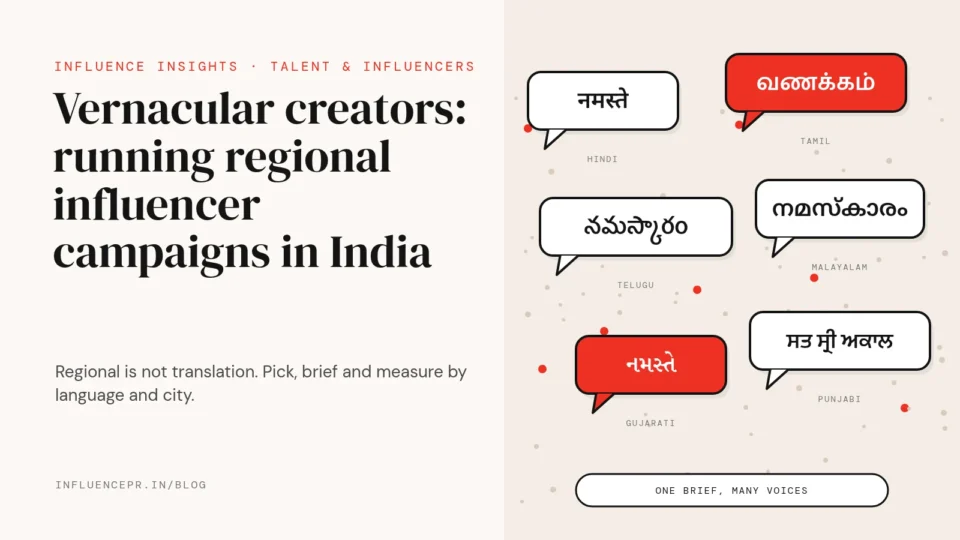
- Languages and regions. Regional language creators widen reach and add briefing, translation and review work; see how to run regional influencer campaigns.
- Compliance load. ASCI’s influencer guidelines put disclosure on both the advertiser and the creator, and finance or health topics need creators with stated qualifications. Checking labels, claims and credentials is real work.
- Rights and exclusivity. Longer usage, paid use and category exclusivity raise both creator fees and contract work.
- Measurement. UTM links, codes, dashboards and cost-per-order tracking take set-up time, and they are what makes the fee accountable.
- Timing. Festive windows compress timelines and push creator demand up. Our festive creator marketing guide covers planning ahead.
The logic is the same as in our guide to what drives PR firm cost in India: price follows outcomes, people, scope, extras and terms.
How do commission and performance fees work in 2026?
Commerce platforms are pulling creator pay towards sales. Storyboard18 reported that Myntra is tripling creator commissions for the festive period, and quoted its VP Marketing: “Creator commerce is moving from being a reach-and-engagement play to becoming a measurable part of the commerce funnel.” At the IIGC roundtable, one participant described tracking creator work through UTMs and cost-per-order models.
Attribution is still messy. In ETRetail, Theater’s co-founder and CEO said influencer marketing does not fit neatly into customer acquisition cost calculations, because people may discover a product through a creator and buy it days later through another route. INALSA’s CEO described the company’s own figure for sales shaped by influencer and social activity as an indicative estimate rather than directly attributed sales. So if you pay on performance, write down which sales count, the attribution window, how returns are handled and what happens to sales you cannot track. Our affiliate and commission programmes work starts with those rules.
How do you set a budget without a benchmark?
- Write the outcome and the date. For example, sign-ups in two cities by a launch date, or marketplace sales during a festive week.
- Pick the fee model that fits the outcome. Awareness and launches suit fixed fees; trackable sales suit commission or performance elements.
- Ask each partner to price per line. Partner fee, creator fees, rights, production, product and paid media as separate lines.
- Add tax and compliance. GST on the fee, TDS on products creators keep, and time for disclosure and claim checks.
- Set a review point. Agree what you will look at after the first campaign or month and what changes after it.
If the total is more than you can spend, cut creators, formats or regions rather than asking for the same scope at a lower fee.
How do you compare quotes line by line?
| Line | What good looks like in writing | Red flag |
|---|---|---|
| Partner fee | Model, amount, what it covers and named people | One bundled number |
| Creator fees | Per creator, with invoices available | Undisclosed mark-ups |
| Rights and exclusivity | Duration, platforms, paid use and category per creator | “Full rights” with no terms |
| Extras | Production, travel and revisions priced in advance | “As required” with no rates |
| Compliance | Written disclosure and claim check before posting | Labels left to the creator |
| Measurement | Baseline, tracking method and a sample report | Reach and likes only |
| Performance terms | Attribution window, returns rule, payout timing | “Commission on sales” undefined |
How does Influence approach fees?
Influence is a PR and integrated marketing consulting firm. We scope creator work from the outcome first, through our creator partnerships practice and SIGND by Influence, our influencer and celebrity marketing platform. Our measurement work sets the baseline and tracking before money moves. We put scope, people, exclusions and the measurement plan in writing before we discuss a number.
Running creator work in the UAE as well as India? Budget for the UAE advertiser permit and local briefing norms separately from the India fee model. Start with PR consultants in Dubai for Indian brands for the cross-border checklist, then come back to the fee table above for the India side.
Frequently asked questions
How much do influencer marketing partners charge in India?
There is no independent survey of partner fees in India, so any single number is one firm’s claim. Where a firm publishes its own fee, treat it as that firm’s price, not a market rate: one Noida firm, for example, charges Rs 75,000 or 10% of media management, whichever is higher, plus GST. Your fee depends on scope, creators, rights and reporting.
Are creator fees included in the partner’s fee?
Usually not. Most partners bill their management fee separately from what creators are paid, and paid media, production and usage rights are often extra too. Ask for each as a separate line in the quote.
Is a percentage-of-spend fee a bad idea?
Not always, but it creates an incentive to grow the budget rather than the result. If you accept it, ask for a minimum and a cap, creator invoices you can audit, and a measurement plan agreed before the campaign starts.
Do we pay TDS on products we give creators?
The Income Tax Department says a product a social media influencer keeps is a benefit that attracts TDS under section 194R, at 10% where the year’s total crosses Rs 20,000, while a product returned after use is not. Confirm the current rule and who files it with your tax adviser.
Should we pay creators on commission only?
Commission works best for ecommerce and D2C brands with clean tracking and a clear returns policy. For launches and awareness, where people often buy days later through another route, a fixed fee plus a performance bonus is usually fairer to both sides.
What commission do influencer marketing partners take in India?
There is no standard rate. One firm, DigiStreet Media, publishes its fee as Rs 75,000 or 10% of media management, whichever is higher, plus GST. A brand founder quoted by ETBrandEquity in October 2026 put a primary partner’s share at 10 to 15% of the campaign budget, with further intermediaries possible on top. Ask for the fee as a separate line.
How much of an influencer budget reaches the creator?
It depends on how many intermediaries sit in the chain. An Open Grey co-founder told ETBrandEquity that in some campaigns a creator may receive Rs 40 of every Rs 100 a brand spends. Ask for each creator’s invoice amount and the names of every intermediary before you sign.
Is a commission on sales the same as a partner commission?
No. A partner commission or percentage fee is what you pay the firm that runs the work. A sales commission is what a creator earns on tracked orders, such as the creator commissions Myntra tripled for the 2026 festive period. Contracts should treat them as separate lines with separate rules.
When should creators be paid?
Agree a date in writing. ETBrandEquity describes 30 to 90 day cycles as the usually stated norm, and some platforms now aim to pay faster. Late creator payment is a reputation risk for your brand, even when you have already paid the partner.
Want a second pair of eyes on a creator budget? Tell us the goal and the quotes you have, and we will help you compare them line by line. Book a consultation with Influence.
Related reading
- How to choose an influencer marketing partner in India: a 2026 checklist
- How much does a PR firm cost in India? What drives the quote
- Festive creator marketing in India 2026: where the Rs 900 crore goes and how to plan yours
Sources
- DigiStreet Media, Influencer Marketing Cost in India 2026 (firm’s own published fee)
- InfluencerMetric, guide to influencer marketing fees in India
- Storyboard18, Myntra triples creator commissions (9 October 2026)
- Social Samosa, Where creator-brand partnerships fall short: IIGC roundtable (October 2026)
- ETRetail, Festive marketing faces an ROI test as brands shift towards creators (16 October 2026)
- Income Tax Department, TDS on benefit or perquisite (section 194R)
- ASCI, Guidelines for Influencer Advertising in Digital Media
- ETBrandEquity, The middle kingdom: where is the money going in influencer marketing (21 October 2026)
For scope and process, see our influencer marketing page.
3 responses
Responses are closed for this insight.