Short answer: Choose celebrities when you need fast, mass recognition in a category or season that rewards fame. Choose creators when you need targeted reach, steady content and sales you can measure. TAM data shows celebrity TV ad volumes fell in 2025, so most Indian brands should anchor 2026 budgets on one and add the other on purpose.
Last updated: 27 October 2026
Celebrity marketing borrows the fame of a public figure to make a brand familiar fast; influencer marketing borrows the trust a creator has built with a specific audience to make a brand relevant.
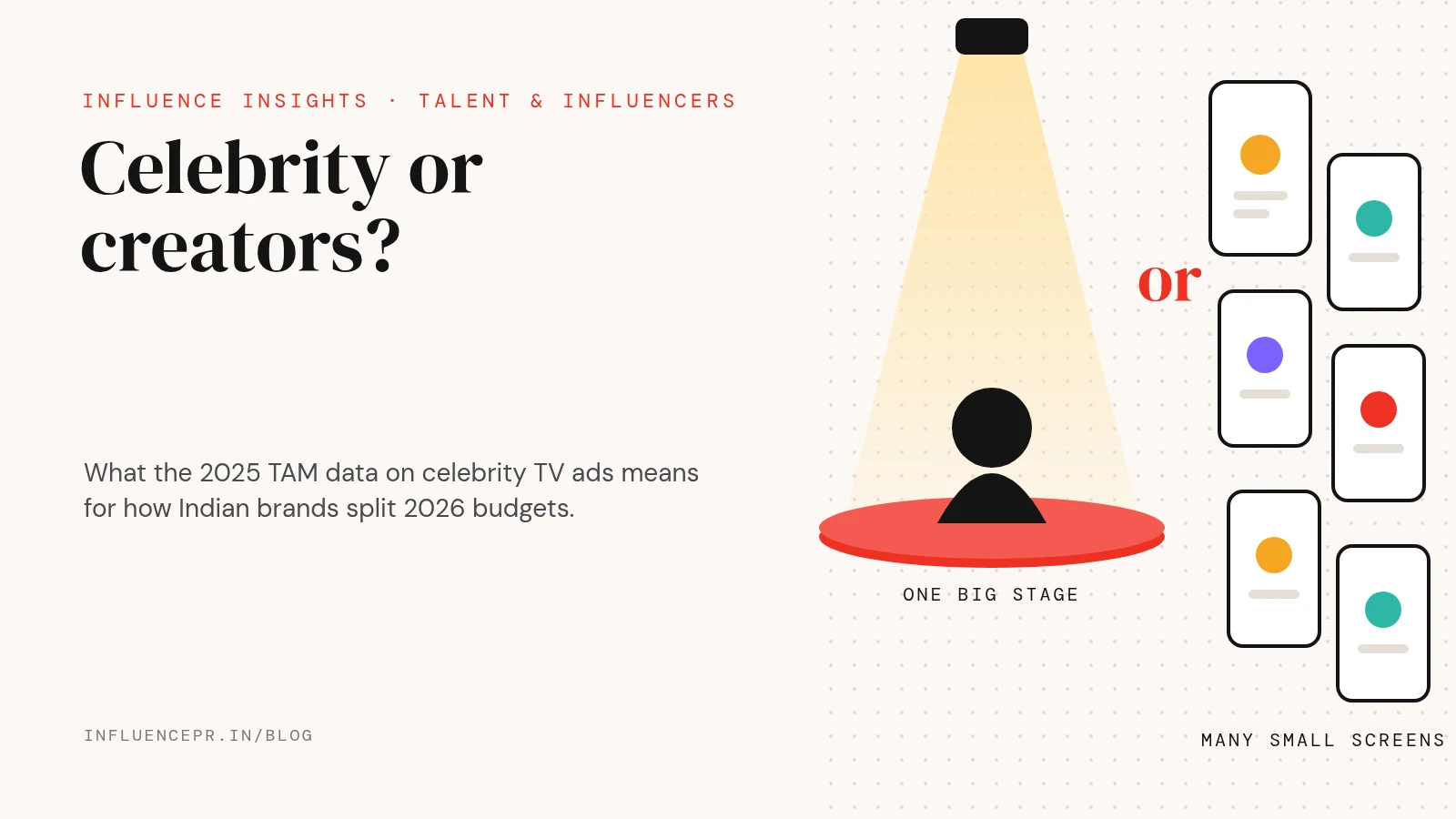
Every brand planning its 2026 calendar meets the same fork: sign a famous face, or spread the money across creators. Most articles on celebrity vs influencer marketing answer it with US examples and no numbers. This guide uses India’s own data, starting with the TAM AdEx report on celebrity-led TV advertising in 2025, adds what the two main estimates of India’s influencer market say, and ends with a decision table you can take into a budget meeting.
What did the 2025 TAM data actually show?
TAM Media Research publishes an annual report on celebrity-endorsed TV commercials. The 2025 edition was covered in detail by Storyboard18, MediaNews4U and BusinessLine on 29 January 2026. The headline numbers:
| Measure (TV advertising, 2025) | Finding | Source |
|---|---|---|
| Ads with a celebrity endorser | 27% of TV ad volumes; 73% featured non-celebrities | Storyboard18 |
| Change in celebrity ad volumes | Grew 3% in 2024 over 2023, then fell in 2025; index 80 against 2023 = 100. BusinessLine puts the fall from 2024 to 2025 at 23 per cent | MediaNews4U; BusinessLine |
| Who fronts celebrity ads | Film stars 73% of celebrity ad volumes: male film actors 43%, film actresses 29%. Sports personalities 20% | Storyboard18 |
| Sectors | Food and beverages 24%, personal care and hygiene 16%, household products 10%. Top three sectors nearly 49%, top seven 79% | Storyboard18 |
| Seasonality | Peak in April to June (IPL). Average daily ad duration fell from 347 hours in April to June to 239 hours in October to December. March (10.7%) and May (10.5%) had the highest monthly shares | Storyboard18 |
| Most endorsers by category | E-commerce and gaming (41 celebrities), then e-commerce media, entertainment and social media (34), building materials and systems (32) | Storyboard18 |
| Most active faces | MS Dhoni endorsed the most brands (59, up from 52 in 2024). Shah Rukh Khan was the most visible, with a 10 percent share and nearly 30 hours of daily ad presence | Storyboard18 |
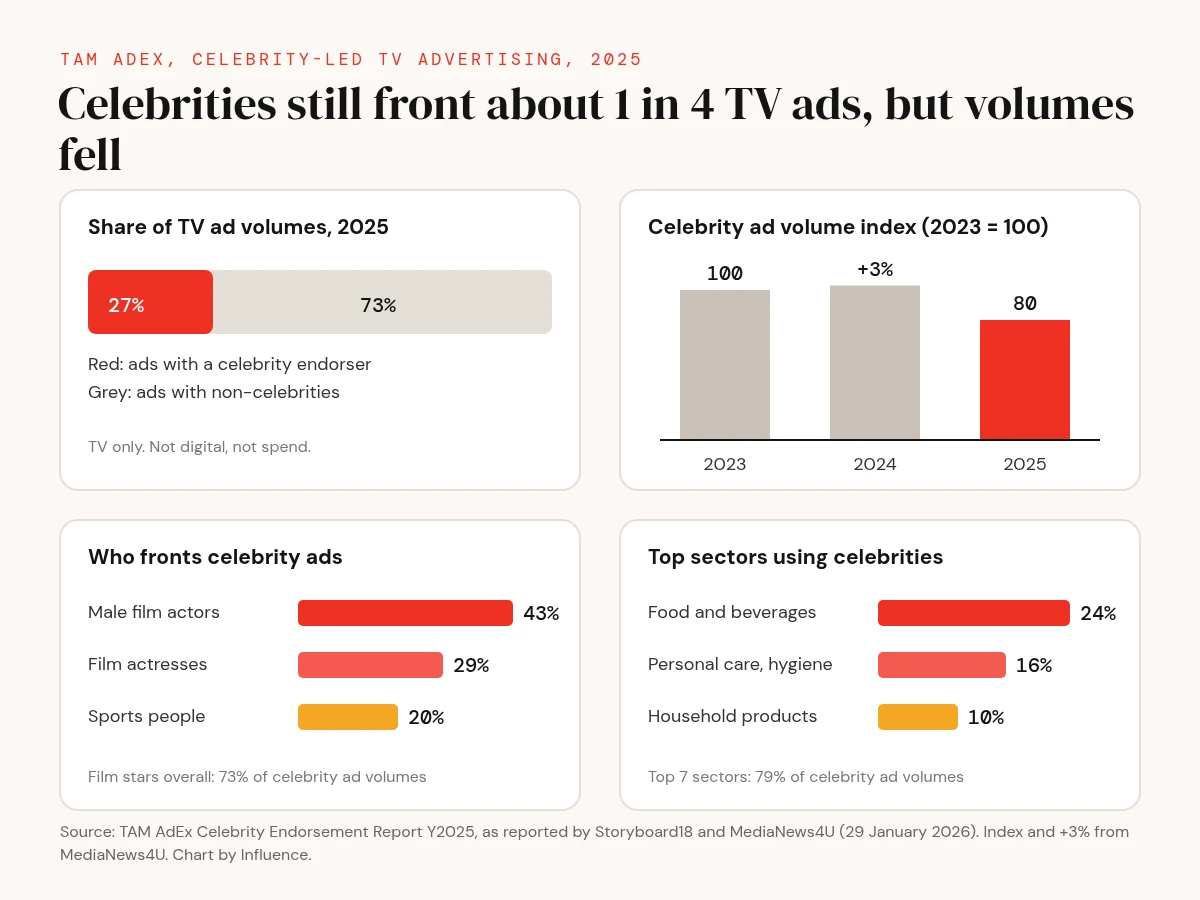
Read it with one limit in mind. TAM AdEx measures TV ad volumes. It does not measure spend, and it does not include celebrity posts on Instagram or YouTube. A brand that moved its star from TV to digital shows up here as a decline. So the data tells you where celebrities are used on TV, not whether celebrities are worth less.
What does the January to September 2026 TAM data add?
A TAM AdEx report on the first nine months of 2026, covered by The Economic Times on 21 October 2026, shows the slide continuing:
- Celebrity-endorsed TV ad volumes fell 17% in January to September 2026, compared with the same period of 2025.
- Film actors and actresses fronted 65% of celebrity-endorsed advertising, down from 72% a year earlier, while sports personalities rose from 19% to 28%.
- Shah Rukh Khan held a 10% share of celebrity-endorsed ad volumes, MS Dhoni 8% and Jasprit Bumrah 3%. Akshay Kumar led brand associations with 35 brands.
- Food and beverages stayed the largest sector at 25% of volumes, followed by personal care and hygiene at 18%. April to June, the IPL quarter, peaked again at 308 hours of average daily celebrity ad volume.
For 2026 budgets the signal matches 2025, with one shift: when brands do sign a famous face for TV, they are choosing athletes more often. TAM Media CEO LV Krishnan linked this to year-round sport and to brands courting Gen Z audiences.
Is influencer marketing replacing celebrity endorsement in India?
Not replacing. Narrowing and concentrating. MediaNews4U’s reading of the TAM report is that the 2025 fall “does not necessarily indicate waning confidence in celebrity endorsements”. It points instead to rising endorsement costs, greater scrutiny on ROI and a partial move of celebrity-led campaigns to digital and social platforms, with advertisers choosing “fewer but more impactful celebrity associations”.
TAM Media’s Anshu Yardi, Vice President Business Partnerships and Communication, told BusinessLine: “There is a clear shift towards formats that offer sharper measurability, cost efficiency, and more authentic consumer engagement.” In the same report, Brand Finance’s Ajimon Francis expected celebrity ads to shrink towards categories such as fashion, lifestyle, vacations and luxury that sell on aspiration, and strategist Lloyd Mathias expected a move from mega celebrities to hyper-local celebrities and subject-matter experts such as chefs and young entrepreneurs.
Meanwhile the creator side keeps growing, though estimates differ by scope:
- WPP Media’s India Influencer Marketing Report 2025 (released with Kantar, June 2025) estimates the industry at Rs 3,600 crore in 2024, with 25% growth forecast for 2025.
- EY (April 2024) projects the sector at Rs 3,375 crore by 2026, at an 18% CAGR.
Treat these as two different measurements, not one market size. What they agree on is direction.
Individual brands show the same split. In Mint (January 2025), Perfora founder Jatan Bawa said the oral care brand had spent 1 to 2% of its annual marketing budget on a couple of celebrity endorsements over two years, against 15% regularly on influencers. That is one brand’s choice, not a benchmark, but it is a common shape: celebrities as occasional moments, creators as an always-on line.
Celebrity vs influencer marketing: how do they compare?
| Factor | Celebrity endorsement | Creator (influencer) marketing |
|---|---|---|
| What you are buying | Fame and instant recognition | Trust with a specific audience |
| Reach | Broad, national, across TV, outdoor and digital | Narrower, by interest, city or language; scales by adding creators |
| Why people respond | Aspiration and familiarity with the face | Relatability and the creator’s track record in a niche |
| Content volume | A shoot, a few films and posts | Many pieces over weeks, often reusable in ads |
| Speed and control | Slow to book and approve; tight brand control | Faster; creators shape the format, so briefs matter |
| Measurement | Hard to separate from other marketing; brand lift and recall studies | Tracked links, codes, platform insights; still needs a baseline |
| Concentration risk | One face carries the campaign | Spread across many people |
| Legal duty | Disclose any material connection and do due diligence on claims (DoCA); ASCI labels on any sponsored social post | The same DoCA duty; ASCI labels on every sponsored post |
| Where it is used most (2025 data) | Food and beverages, personal care, household products on TV (TAM) | Brands across categories; WPP Media found 72% of brands prefer long-term partnerships |
A practical note on the creator side: the same WPP Media report found 83% of marketers struggle to find the right talent, and 70% of brands named trust and credibility as the top reason to use influencers. Picking the people is the hard part, which is why our checklist for choosing an influencer marketing partner starts with audience evidence, not follower counts.
Which should you choose for your objective?
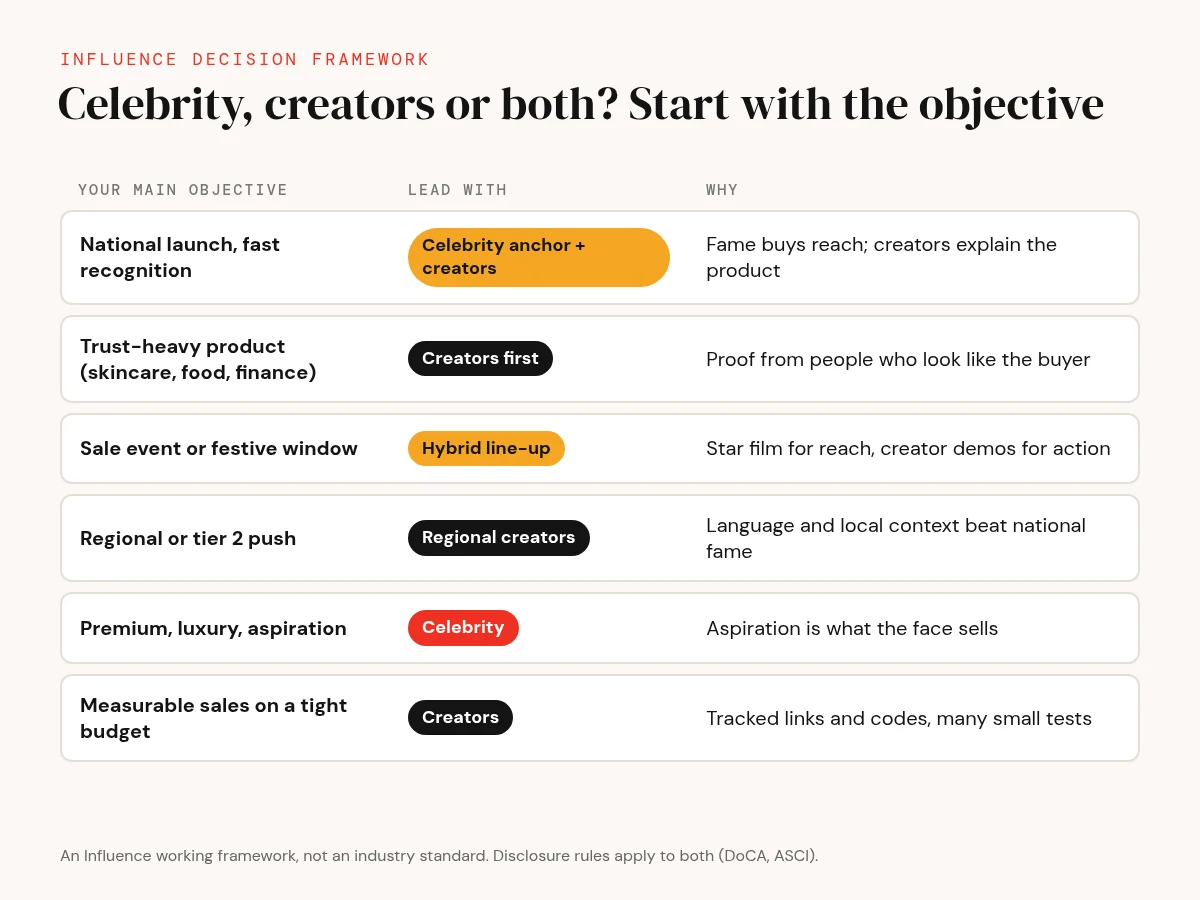
A question we hear from marketers is whether a celebrity campaign ever beats a creator programme. It can, when the objective is recognition at scale and the brand has the media budget to carry the face. Start from the objective, not the person:
| Main objective | Lead with | Add | What to measure |
|---|---|---|---|
| National launch or category entry that needs recognition fast | Celebrity anchor | Creators to explain and demonstrate | Brand recall, branded search, distribution pull |
| Trust-heavy product (skincare, food, health, finance) | Creators with relevant credentials | A celebrity later, once the message is proven | Saves, comments with questions, tracked sales |
| Sale event or festive window | Hybrid line-up | Paid amplification on the best creator posts | Orders by code or link, cost per order |
| Regional or tier 2 push | Regional creators | A regional star where one fits the brand | City-level sales and search |
| Premium, luxury or aspiration | Celebrity | A few tastemaker creators | Brand lift, enquiries, store visits |
| Measurable sales on a tight budget | Creators | Nothing until the tests show a winner | Cost per order against a baseline |
Two checks before you sign anyone. First, can your budget carry the media and production a celebrity needs, not only the fee? Second, is your message proven? A celebrity amplifies a message; creators help you find it. Our talent and ambassador strategy work starts from these two questions, and our guide to choosing a celebrity ambassador covers fit, category clashes and reputation checks.
Weighing a celebrity against a creator line-up for 2026? Share your objective and budget range and we will help you choose the mix before you commit. Book a consultation with Influence.
Can you use both? The anchor-plus-creators model
Yes, and the 2026 festive season shows how. Flipkart’s Big Billion Days campaign ran personality-led films with Karan Kundrra, Tejasswi Prakash and Malavika Mohanan, and brought in food, home and lifestyle creator Kabita Singh for a creator-led take on the same appliances (passionateinmarketing.com, 9 October 2026). Epigamia paired filmmaker Farah Khan with chef Dilip for a series of short-form videos over two months, starting with an Instagram Reel (ETBrandEquity, 19 October 2026). We cite these as formats, not as results; neither report gives outcome data.
How to run a hybrid line-up well:
- One message, two jobs. The celebrity makes people notice; creators show the product in use. Write one core message and separate briefs.
- Sequence it. Launch the celebrity film first, then release creator content while attention is high, then put paid media behind the creator posts that perform.
- Settle rights early. Usage period, platforms, paid amplification, category exclusivity and approval rounds differ for each person. Our structuring celebrity and creator deals page covers what to fix in writing.
- Measure both on one plan. Recall and branded search for the celebrity; links, codes and cost per order for creators.
Running both sides is also how SIGND by Influence, our influencer and celebrity marketing platform, works: brands partner with celebrities and creators from different disciplines through one team.
What does the law expect from both?
The legal duty is the same for a film star and a food creator. The Department of Consumer Affairs guide Endorsements Know-hows! (January 2023) applies to celebrities, influencers and virtual influencers. It requires disclosure of any material connection with the advertiser, including money, free products, trips or hotel stays and family or employment ties, using terms such as “advertisement”, “sponsored” or “paid promotion”. It also says endorsers should not endorse a product or service they have not personally used or experienced, or on which they have not done due diligence.
ASCI’s influencer guidelines list the labels it accepts (including Ad, Sponsored, Collaboration, Partnership, Free gift and the platforms’ paid partnership tags) and place responsibility on both the advertiser and the influencer. The advertiser may call on the influencer to edit or delete a post. If you plan to use AI-generated or virtual faces, read our explainer on ASCI’s AI labelling rules too.
How should you budget when there are no reliable rate cards?
We do not publish invented fee bands. What drives the total cost is predictable, so budget by drivers:
- Celebrity: the fee, the usage period and platforms, category exclusivity, number of shoot days, production, travel and approvals, and the paid media needed to make the film seen. For the production side, see what a brand film costs in India, line by line.
- Creators: the number and tier of creators, usage rights and paid amplification of their posts, production support, revision rounds, GST and TDS.
- Both: the cost of measurement and of the people who check every disclosure before it goes live.
For how creator programmes are priced, see our guide to what influencer marketing partners charge.
How does Influence approach celebrity and creator work?
Influence is a PR and integrated marketing consulting firm. We plan celebrity and creator work from the business objective first, through our talent strategy and creator partnerships practices and SIGND by Influence. We will tell you when a celebrity is the wrong buy.
Frequently asked questions
Is influencer marketing cheaper than celebrity endorsement?
Usually per campaign, but not always per result. A celebrity fee is one large commitment, and it often needs production and paid media behind it. A creator programme spreads money across many smaller deals you can test and stop. Compare total cost against the outcome you need, not fee against fee.
Are celebrity endorsements the same as influencer marketing?
No. A celebrity endorsement uses the fame of a public figure, usually across TV, print, outdoor and digital. Influencer marketing pays creators whose audience follows them for their content on a platform. The lines blur when a celebrity posts on their own Instagram, but the legal duty to disclose applies to both in India.
Do celebrities need to disclose paid posts in India?
Yes. The Department of Consumer Affairs guide Endorsements Know-hows! applies to celebrities, influencers and virtual influencers. Any material connection with the brand, including payment, free products, trips or family ties, must be disclosed prominently with terms such as advertisement, sponsored or paid promotion.
What are the disadvantages of celebrity endorsement?
High upfront cost, limited content volume, a short campaign window, results that are hard to separate from other marketing, exposure if the celebrity faces controversy, and growing legal responsibility for the claims they endorse. The ad may also make people remember the face more than the product.
Can a brand use a celebrity and creators in one campaign?
Yes, and many Indian brands now do. Flipkart’s Big Billion Days films paired actors with food and home creator Kabita Singh in 2026. Agree one message, separate briefs, clear usage rights and exclusivity terms for each person, and one measurement plan across both.
Want a second opinion on your 2026 talent plan? Tell us the objective, the categories and the names you are considering, and we will help you decide between a celebrity, creators or both. Book a consultation with Influence.
Related reading
- How to choose an influencer marketing partner in India: a 2026 checklist
- What influencer marketing partners charge in India: retainers, commissions and project fees
- Festive creator marketing in India 2026
Sources
- The Economic Times, Celebrity-endorsed TV ad volumes fall 17% as sports stars gain ground (21 October 2026)
- TAM Media Research, TAM AdEx Celebrity Endorsement Report Y2025
- Storyboard18, Celeb endorsements lose steam on TV; SRK and MS Dhoni dominate brand recall: TAM (29 January 2026)
- MediaNews4U, Celebrity-led TV ad volumes dip in 2025: TAM AdEx (29 January 2026)
- BusinessLine, Authentic advertising kills celebrity-endorsed ads: report (29 January 2026)
- WPP Media, Influencing with Integrity: India Influencer Marketing Report 2025 (10 June 2025)
- EY India, How influencer marketing is impacting brands in India (2 April 2024)
- Mint, Celebrities lose ground on endorsements as more brands turn to influencers (27 January 2025)
- PIB, Department of Consumer Affairs releases Endorsements Know-hows! (20 January 2023)
- ASCI, Guidelines for Influencer Advertising in Digital Media
- passionateinmarketing.com, Flipkart Big Billion Days talent films (9 October 2026)
- ETBrandEquity, Epigamia ropes in Farah Khan and Chef Dilip (19 October 2026)
Related: for the talent side of the deal, see our celebrity management and talent PR practice.
See how we run influencer and celebrity marketing for brands.
4 responses
Responses are closed for this insight.