Short answer: If your founder has no personal brand, do not start by posting more. Spend 30 minutes checking what search, LinkedIn, your website, the press and AI assistants say about them. Fix findability and credibility first, then pick one point of view and one channel, run a 30-day starter plan and measure inbound.
Last updated: 31 October 2026
A founder is invisible online when someone who searches their name cannot quickly find who they are, what they stand for and why they are credible.
It happens to good companies all the time. The business has customers, revenue and a real view of its market, and the person who built it is unknown outside a small circle. The usual reaction is to start posting. That is the wrong first step. This post shows how to diagnose the gap in half an hour and what to fix, in order, in the first 30 days.
How do you know your founder is invisible online?
Five symptoms show up again and again:
- Search returns someone else, or nothing. The first page for the founder’s name shows a namesake, an old employer or a directory listing.
- The LinkedIn profile is a job title. “Founder at X”, no About section, no Featured items, last post months ago.
- The company website has no founder page. Or the About page names the founder without saying anything about them.
- There is no press record. Nothing a journalist, investor or candidate can check, or only paid placements.
- AI assistants cannot describe the founder. Ask ChatGPT, Gemini or Perplexity “Who is [name], founder of [company]?” and the answer is vague, wrong or about someone else. (If the assistants name rival companies instead of yours, see how to get your brand mentioned in ChatGPT.)
If three or more apply, the founder is invisible to the people who matter, whatever the company’s results.
Why does it matter if the founder has no personal brand?
Because people check the founder before they act. Investors look before a first meeting, candidates before an interview, journalists before they quote, and enterprise buyers before they sign.
- Reputation. In a 2015 Weber Shandwick survey of more than 1,700 executives at companies with revenue of $500 million or more, respondents attributed on average 45% of their company’s reputation to the CEO’s reputation, and said a strong CEO reputation helps attract (77%) and retain (70%) employees (Weber Shandwick). That research covers large companies, not startups, but the link is hard to ignore at any size.
- Timing. The 2024 Edelman and LinkedIn B2B Thought Leadership Impact Report, citing the Ehrenberg-Bass Institute, notes that at any given moment about 95% of business clients say they are not actively looking to buy (Edelman). Visibility is how you are remembered when they start.
- Hiring. LinkedIn found that 94% of professionals at companies with 10 to 49 employees said their professional network was important in navigating their careers (CIOL, 16 October 2026). Small teams hire through networks, and the founder’s is the biggest one the company has.
What is the Founder Visibility Audit?
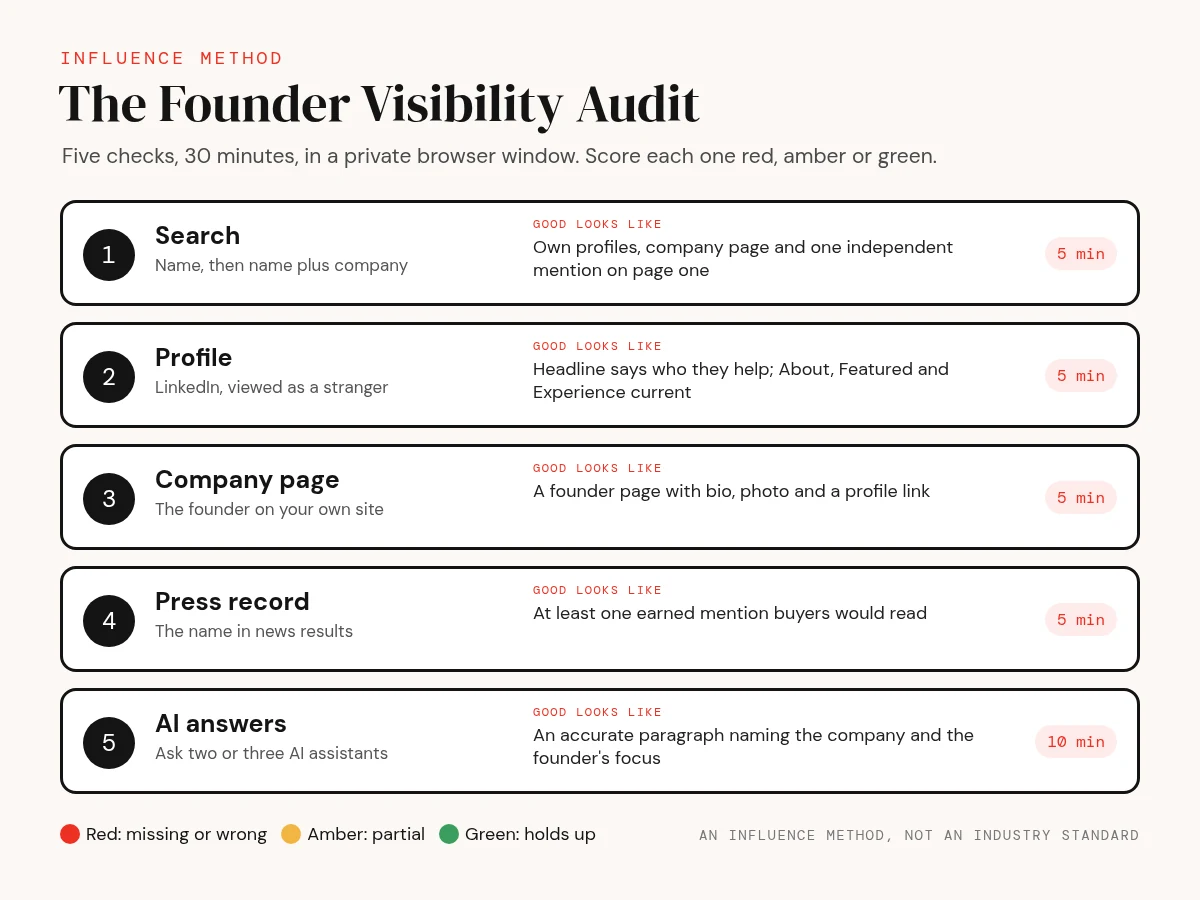
It is a 30-minute check we run before any founder work starts, an Influence method rather than an industry standard. Do it in a private browser window so your own history does not colour the results.
| Check | What to do | What good looks like | Time |
|---|---|---|---|
| 1. Search | Search the founder’s name, then name plus company | Page one shows the founder’s own profiles, company page and at least one independent mention | 5 min |
| 2. Profile | Open their LinkedIn as a stranger would | Headline says who they help; About, Featured and Experience are complete and current | 5 min |
| 3. Company page | Find the founder on your own website | A founder or leadership page with a short bio, photo and a link to their profile | 5 min |
| 4. Press record | Search the name in news results | At least one earned mention in a publication your buyers read | 5 min |
| 5. AI answers | Ask two or three AI assistants who the founder is | An accurate one-paragraph answer that names the company and what the founder is known for | 10 min |
Score each check red, amber or green. If three or more checks are red, work through the fixes below in this order.
Which gap should you fix first?
Fix them in this order: findable, credible, distinctive, active, measured. Posting comes fourth, not first, because posts send people to a profile and a search result that have to hold up.
| Symptom | Likely cause | First fix |
|---|---|---|
| Search shows a namesake or nothing | No pages that clearly belong to the founder | A founder page on the company site and a complete LinkedIn profile that use the same name, title and photo |
| Profile is just a job title | No decision about positioning | Write one sentence: “I help [audience] with [problem] because [reason]”, then rewrite the headline and About from it |
| No press record | No story beyond the company’s milestones | Find one claim about your market a journalist would want to test; do not lead with a funding round |
| AI answers are vague or wrong | Few consistent public facts to draw on | Make the same facts appear on your site, LinkedIn and any directory profiles |
| Posts get likes but no conversations | Topics not tied to what the company sells | Narrow to four to six pillars your buyers care about |
What should a founder do in the first 30 days?
| Week | Focus | Done when |
|---|---|---|
| 1 | Audit and position | Visibility Audit scored; positioning sentence agreed |
| 2 | Findable and credible | LinkedIn profile rewritten; founder page live on the company site with consistent facts |
| 3 | First point of view | Two posts published from one recorded conversation about what the founder sees in the market |
| 4 | Conversations and review | Comments on 20 to 30 relevant accounts; audit re-run and compared with week 1 |
For the full LinkedIn method, from profile to measurement, read our guide on how to build a personal brand on LinkedIn as a founder.
Not sure where your founder stands? We can run the Visibility Audit with you and show you the first three fixes. Book a consultation with Influence.
Is staying low-profile ever the right call?
Sometimes. A stealth founder keeps quiet on purpose before launch, and before product market fit the positioning often keeps moving, so heavy publishing can lock in a story that changes in six months. Invisible by choice is fine. Invisible by neglect is the problem. Either way, make sure the basics are accurate, so a search of the founder’s name returns facts rather than nothing.
Who owns a founder’s brand: the founder or the company?
The founder owns their name and voice; the company owns its brand. The two should agree on facts, such as titles, numbers, customers you are allowed to name and positioning, while the founder carries opinions, lessons and the reasons behind decisions. Put the rules in writing early, especially for co-founders and for anything that touches investors or listed partners.
Should you fix it yourself or get help?
The audit and the first 30 days are doable in-house if the founder gives an hour or two a week. Get help when the founder has strong views but no time, when the press record needs real stories placed, or when visibility has to be tied to a fundraise, a launch or hiring. Influence is a PR and integrated marketing consulting firm. Our Founder Authority Programme runs this over twelve months on the 5C Framework (Clarify, Create, Command, Convert, Compound), our LinkedIn Operating System runs the publishing, and our founder press and profiles work builds the record journalists and investors check. You can see the whole founder practice here.
Frequently asked questions
What does it mean when a founder has no personal brand?
It means people who look the founder up cannot quickly find who they are, what they stand for and why they are credible. The company may be doing well, but the founder’s name returns an empty or out-of-date profile, no point of view and no record anyone can check.
Why is building a personal brand important for a founder?
Investors, candidates, journalists and buyers check the founder before they reply. A clear, credible presence makes those checks work for the company. In a 2015 Weber Shandwick survey of executives at large companies, respondents attributed on average 45% of their company’s reputation to the CEO’s reputation.
Who owns a founder’s brand, the founder or the company?
The founder owns their name and voice; the company owns its brand. Keep the facts consistent between the two, such as titles, numbers and positioning, and let the founder carry opinions, lessons and the story behind decisions. Agree in writing what the founder can say about the company.
How long does it take for a founder to become visible online?
The basics, a findable and credible profile, take a week or two. A recognisable point of view takes a few months of steady publishing. Earned press usually takes longer and needs a genuine story. Judge progress by inbound conversations, not follower counts.
Is it ever better for a founder to stay low-profile?
Sometimes. A stealth founder may keep quiet before launch, and before product market fit the positioning often keeps moving. Even then, make sure a search of your name returns an accurate profile, so the people who check you find facts rather than nothing.
Want your founder to be findable, credible and remembered? Share where things stand and we will map the first 30 days. Book a consultation with Influence.
Related reading
- How to build a personal brand on LinkedIn: the complete guide for founders
- How to run a corporate reputation audit: a step-by-step framework
- How much does a PR firm cost in India? What drives the quote
Sources
- Weber Shandwick, 81% of global executives report that external CEO engagement is now a mandate for building company reputation (5 March 2015)
- Edelman and LinkedIn, 2024 B2B Thought Leadership Impact Report
- CIOL, Zepto leads LinkedIn’s 2026 list as new startups gain ground (16 October 2026)
5 responses
Responses are closed for this insight.