
Short answer: To build a personal brand on LinkedIn as a founder, decide what you want to be known for, fix your profile so it says that in seconds, pick four to six content pillars, post on a rhythm you can keep, spend as much time commenting as posting, share proof, and measure inbound conversations rather than likes.
Last updated: 4 November 2026
A founder’s personal brand on LinkedIn is the reputation buyers, hires and investors form from your profile, posts and comments before they ever meet you.
Most founders know they should be visible on LinkedIn. Many start, post for a few weeks, and stop. The problem is rarely writing skill. It is the lack of a decision about what to be known for, and a system that removes the blank page every week. This guide sets out the method we use with founders, step by step, so you can run it yourself or know what to ask for if you get help.
Why should a founder build a personal brand on LinkedIn?
Three reasons, in order of how often they pay off for founders:
- Buyers. LinkedIn says it has a community of more than 1.4 billion members, with more than 427 million in Asia Pacific, which includes India (LinkedIn Pressroom). Your buyers are there whether or not they are shopping today.
- Hires. LinkedIn’s Top Startups India 2026 list ranks companies on employment growth, engagement, job interest and the ability to attract talent, and LinkedIn found that 94% of professionals at companies with 10 to 49 employees said their professional network mattered in navigating their careers (CIOL, 16 October 2026). Candidates read the founder before they read the job post.
- Everyone else who decides about you. Investors, journalists, event curators and partners check your profile before they reply. A clear profile and a visible point of view make that check work in your favour.
Why now, in India? More Indian founders are already making this choice. LinkedIn’s chief communications officer, Nicole Leverich, told afaqs! that the number of people adding “founder” to their LinkedIn profiles has grown 104% in India, compared with 60% globally, and that video content shared on the platform is growing 60% year on year in India (afaqs!, 31 August 2026). Her reading of why the founder voice matters: “People don’t want to hear from an anonymous corporate statement. They want to hear from the person making the decision.”
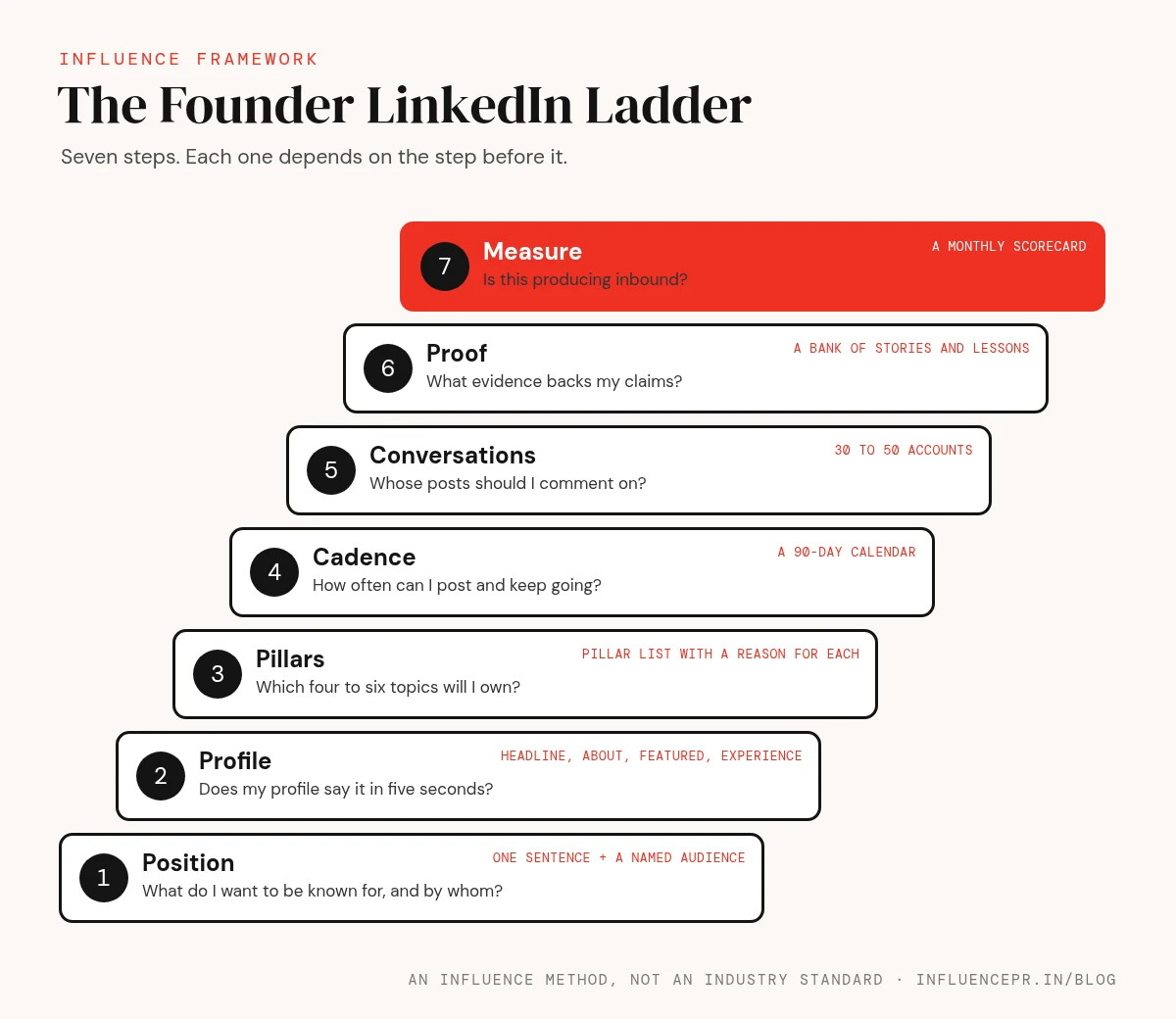
What is the Founder LinkedIn Ladder?
It is our seven-step working method, an Influence framework rather than an industry standard. Each step depends on the one before it:
| Step | Question it answers | Output |
|---|---|---|
| 1. Position | What do I want to be known for, and by whom? | One sentence and a named audience |
| 2. Profile | Does my profile say that in five seconds? | Rewritten headline, About, Featured and Experience |
| 3. Pillars | Which four to six topics will I own? | A pillar list with a reason you are credible on each |
| 4. Cadence | How often can I post and keep going? | A 90-day calendar |
| 5. Conversations | Whose posts should I comment on? | A list of 30 to 50 accounts |
| 6. Proof | What evidence backs my claims? | A bank of stories, numbers you are allowed to share and lessons |
| 7. Measure | Is this producing inbound? | A monthly scorecard |
Step 1: Position. What do you want to be known for?
Write one sentence: “I help [audience] with [problem] because [reason you are credible].” Test it against your buyers, not your peers. A fintech founder who wants CFOs as customers should be known for a view on finance operations, not for startup life in general. If the sentence could describe a thousand other founders, narrow it.
Step 2: How should a founder’s LinkedIn profile look?
Your profile is the page people land on from every post and comment. Fix it before you post more.
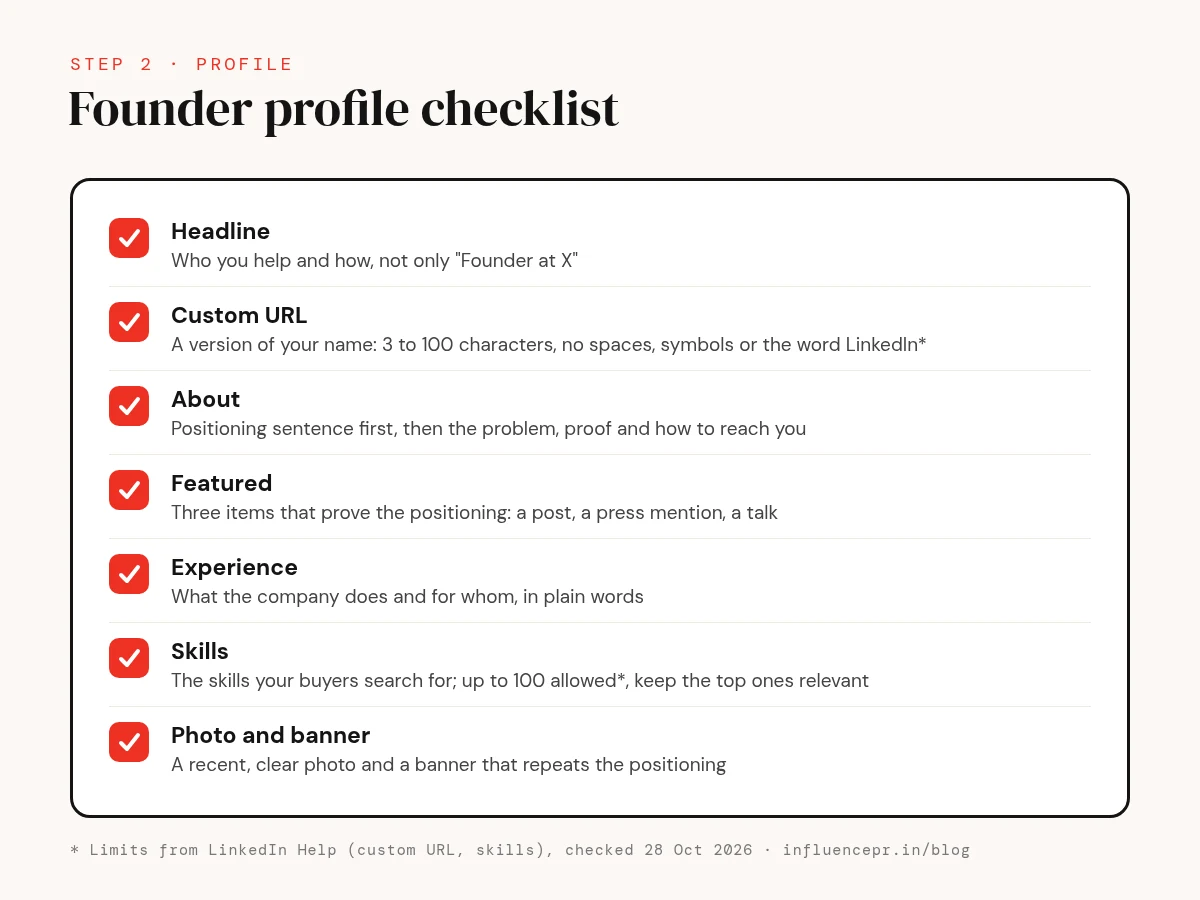
| Profile element | What good looks like for a founder |
|---|---|
| Headline | Who you help and how, not only “Founder at X” |
| Custom URL | A version of your name. LinkedIn allows 3 to 100 characters, with no spaces, symbols, special characters or the word LinkedIn (LinkedIn Help) |
| About | Your positioning sentence first, then the problem you solve, proof, and how to reach you |
| Featured | Three items that prove the positioning: a strong post, a press mention, a talk or a product page |
| Experience | What the company does and for whom, in plain words, with outcomes you are allowed to share |
| Skills | The skills your buyers search for. LinkedIn allows up to 100 (LinkedIn Help); keep the top ones relevant |
| Photo and banner | A recent, clear photo; a banner that repeats the positioning, not a stock image |
Step 3: Which content pillars should you pick?
Pick four to six territories you can defend, each with a reason you are the person to speak on it. Typical founder pillars are a view on your industry, lessons from building the company, how your customers’ problem is changing, hiring and culture, and a personal pillar that shows who you are. Our page on content pillars explains how we test pillars against buyers and refresh them each quarter.
Step 4: How often should founders post on LinkedIn?
As often as you can keep up for 90 days. For most founders that is two or three posts a week. Plan a 90-day calendar by pillar, so each week starts from a prompt, not a blank page. A practical way to fill it is to record a 15-minute conversation each week about what happened in sales calls, hiring and product, and turn it into drafts.
Started on LinkedIn and stalled? Tell us what you want to be known for and we will show you the pillars and cadence we would set. Book a consultation with Influence.
Step 5: Why do comments matter as much as posts?
Posting builds a library. Commenting builds relationships, and it puts your name in front of people who do not follow you yet. List 30 to 50 accounts your buyers, peers and journalists read, and leave specific, useful comments on their posts most weekdays. A comment that adds a number, an example or a counterpoint does more than “Great post”.
Step 6: What proof should you share?
Opinions get attention; proof earns trust. Keep a bank of stories from the business: a decision and why you made it, a mistake and what changed, a customer problem you solved (only with their permission), a hiring lesson. Share numbers only when you are allowed to and they are accurate. Never borrow statistics you cannot source.
Step 7: How do you measure a founder’s LinkedIn brand?
| Measure | Why it matters | Where to find it |
|---|---|---|
| Inbound meeting requests and DMs from target buyers | Closest signal to pipeline | Your inbox and CRM, tagged “LinkedIn” |
| Sales conversations that mention your posts | Shows content is shaping decisions | Ask in every first call |
| Candidates who mention your posts | Hiring pull | Ask in every interview |
| Press, podcast and event invitations | Authority beyond your network | Inbox |
| Profile viewers from target companies | Early interest | LinkedIn profile analytics |
| Followers and impressions | Reach, useful only alongside the above | LinkedIn analytics |
Review monthly. If reach grows but inbound does not, your pillars are interesting but not tied to what you sell.
What is the 95-5 rule on LinkedIn?
The 95-5 rule comes from the Ehrenberg-Bass Institute and is cited by the Edelman and LinkedIn B2B Thought Leadership Impact Report: at any given moment, about 95% of business clients say they are not actively seeking goods or services. For a founder, that means most of the people reading your posts will not buy this quarter. The job of your LinkedIn presence is to be remembered when they do.
Should you do it yourself or get help?
| Option | Suits | Watch for |
|---|---|---|
| Do it yourself | Founders who write easily and have a few hours a week | Stalling after the first month |
| Ghostwriting | Founders with strong views and little time | Posts that do not sound like you |
| A managed system | Founders who want pillars, cadence, comments and measurement run end to end | Measurement tied to likes instead of pipeline |
Influence is a PR and integrated marketing consulting firm. Our LinkedIn Operating System is the managed version of this guide, and our ghostwriting in your voice starts from recorded conversations, not questionnaires. For founders who want LinkedIn as part of wider visibility, see our founder authority programme.
A 90-day plan you can start this week
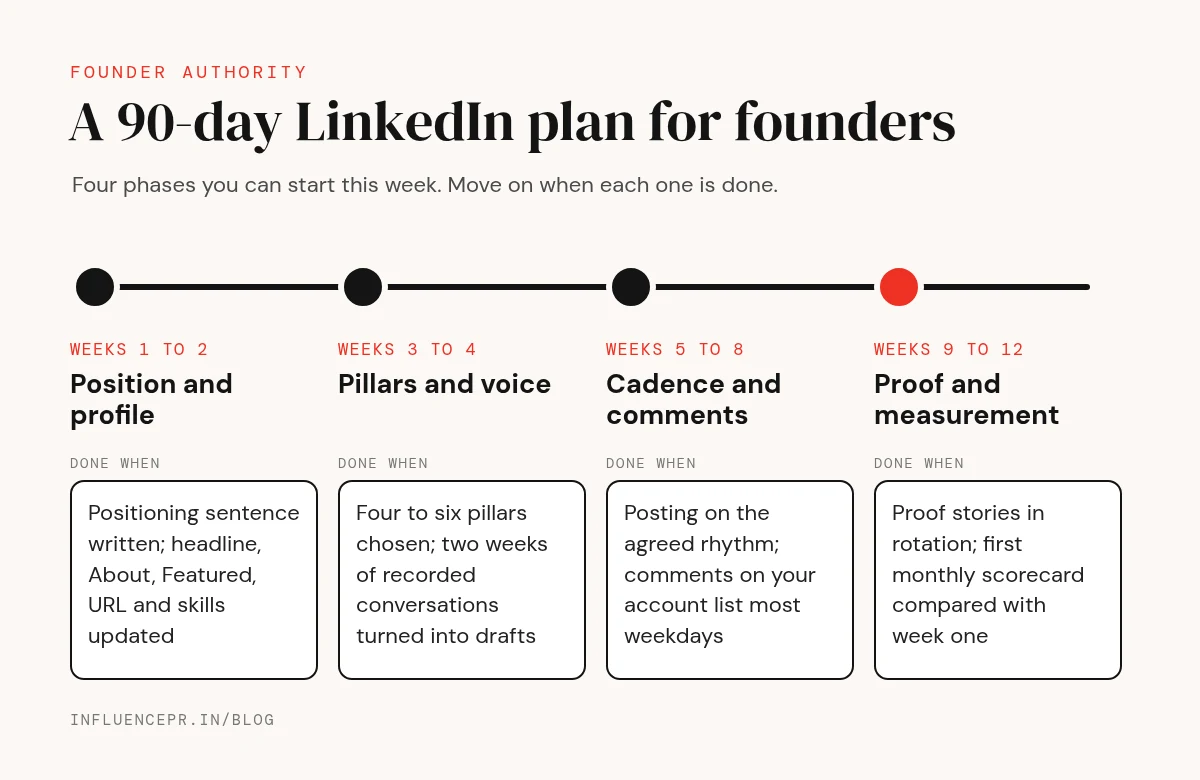
| Weeks | Focus | Done when |
|---|---|---|
| 1 to 2 | Position and profile | Positioning sentence written; headline, About, Featured, URL and skills updated |
| 3 to 4 | Pillars and voice | Four to six pillars chosen; two weeks of recorded conversations turned into drafts |
| 5 to 8 | Cadence and comments | Posting on the agreed rhythm; comments on the account list most weekdays |
| 9 to 12 | Proof and measurement | Proof stories in rotation; first monthly scorecard compared with week one |
LinkedIn is also only one place people look you up. AI assistants and search results increasingly answer “who is this founder?”, so check those too; our corporate reputation audit framework includes a simple AI-answers check. If you want the whole company reviewed, not just the founder, see our corporate reputation audit service. If your founder barely shows up anywhere yet, start with our guide on what to do when a founder is invisible online.
Frequently asked questions
How often should a founder post on LinkedIn?
Pick a rhythm you can keep for 90 days, such as two posts a week plus a few minutes of comments on most weekdays. Consistency matters more than volume, because buyers and hires judge you on the pattern they see over months, not on one busy week.
What is the 95-5 rule on LinkedIn?
It comes from research by the Ehrenberg-Bass Institute, cited in the Edelman and LinkedIn B2B Thought Leadership report: at any moment about 95% of business clients are not actively looking to buy. A founder’s posts work on that 95%, so they remember you when they do enter the market.
Should a founder use a ghostwriter on LinkedIn?
It can work if the ideas and voice are yours and the writer captures them from real conversations. Readers notice generic posts quickly. If a post does not sound like something you would say in a meeting, do not publish it.
How do I measure whether my LinkedIn brand is working?
Track inbound, not likes: meeting requests, sales conversations that mention your posts, candidates who say they follow you, press or event invitations, and profile visits from your target companies. Review the numbers monthly against the month before you started.
Is a founder’s personal brand separate from the company brand?
They overlap but are not the same. The company page speaks for the business; the founder speaks as a person with a point of view. Keep the two consistent on facts and positioning, and let the founder carry opinions, lessons and the story behind decisions.
Want a LinkedIn presence that brings in conversations, not just likes? Share your goals and we will map your first 90 days. Book a consultation with Influence.
Related reading
- How much does a PR firm cost in India? What drives the quote
- How to run a corporate reputation audit: a step-by-step framework
- Our founder is invisible online. Where do we start?
Sources
- LinkedIn Pressroom, About LinkedIn (statistics)
- LinkedIn Help, Manage your public profile URL
- LinkedIn Help, Add and remove skills on your profile
- Edelman and LinkedIn, B2B Thought Leadership Impact Report
- CIOL, Zepto leads LinkedIn’s 2026 list as new startups gain ground (16 October 2026)
- afaqs!, India is leading on AI optimism, founder growth and learning: LinkedIn’s Nicole Leverich (31 August 2026)
Related: founders who want this run for them can see our founder personal branding service and CEO personal branding for CXOs.
Want your name to show up in AI answers too? See AI search visibility.
4 responses
Responses are closed for this insight.