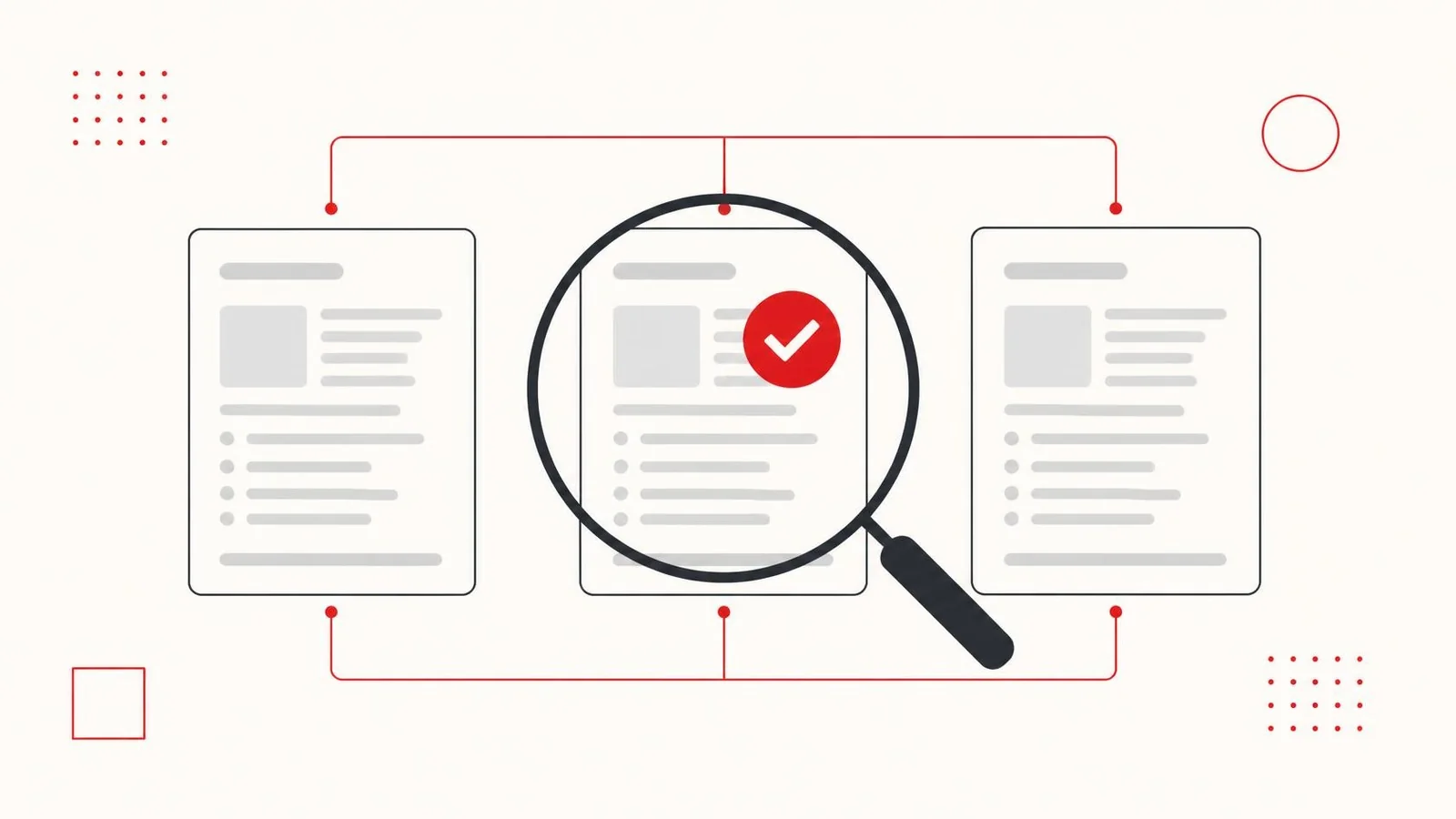
Short answer: To choose a PR firm in India, agree the business outcome you need first, then test three to five firms on four things: fit with your sector and goal, the named people who will run your account, proof you can click, and contract terms tied to agreed outcomes. The twelve questions below cover all four.
Last updated: 13 October 2026
Most companies in India hire a PR firm after a pitch meeting that shows the best of the firm and very little of the day-to-day work. The result is a familiar complaint six months later: the coverage does not match the goal, the senior people disappeared after the pitch, and nobody agreed what success looked like. If you are working out how to choose a PR firm in India, or a consultant, this guide gives you a structured way to compare them before you sign.
What does a PR firm actually do for you?
A PR firm is an outside team you hire to earn, rather than buy, credible attention for your company from the journalists, creators, investors and customers your business needs to persuade. In practice that means shaping your story, preparing spokespeople, building relationships with the right media, handling difficult moments and reporting on what changed (our guide to what a PR agency does breaks this work down activity by activity). Whether a firm calls itself a PR firm or consultancy matters far less than who does the work and how it is measured.
Not sure an outside firm is the right model yet? Compare a PR firm with an in-house hire, a PR firm with a freelance consultant, or the other options to hiring a firm first. Hiring in a specific city? See PR in Mumbai, Bengaluru, Gurugram and Delhi NCR.
Which 12 questions should you ask before you sign?
Group the questions into four stages and ask them in order. A firm that fails the first stage does not need to reach the fourth.
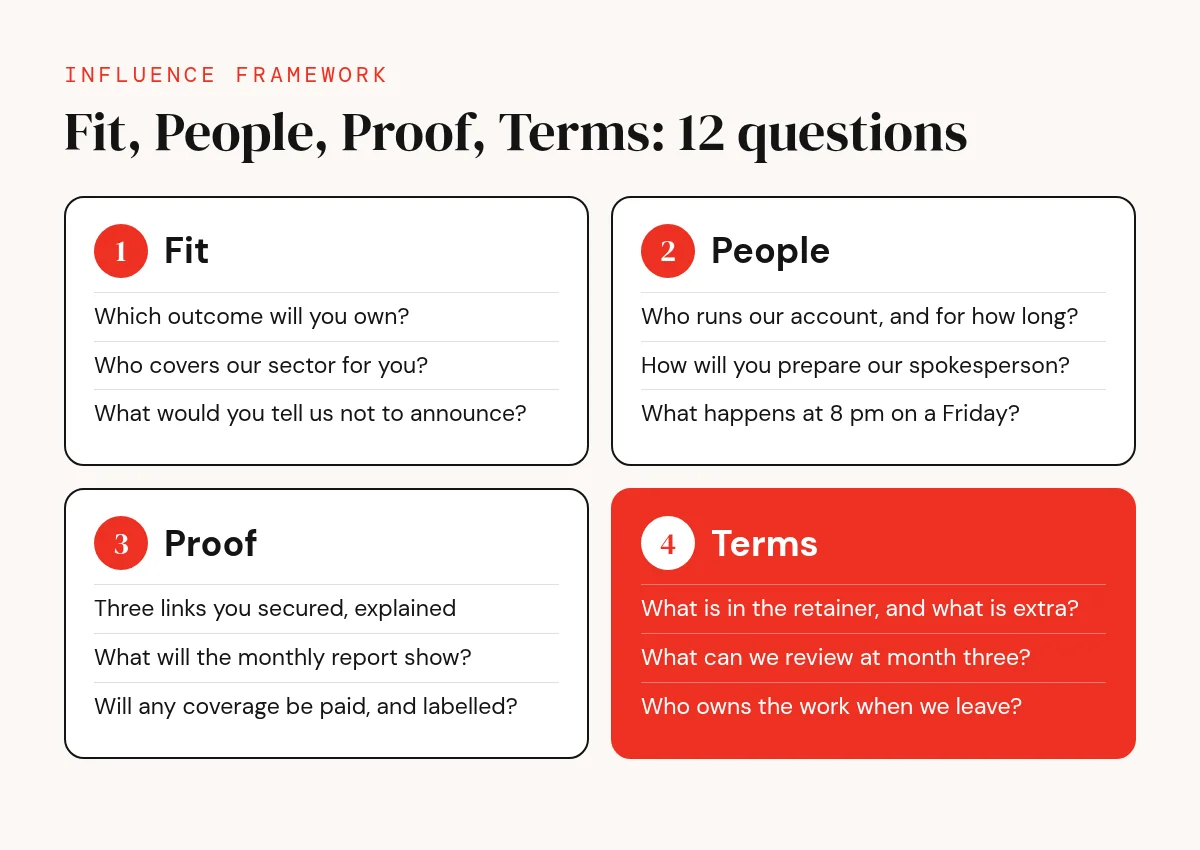
Does the firm fit your goal and your sector?
1. What business outcome will you hold yourselves to in the first six months?
- Why it matters: Every PR plan should serve a business goal: a fundraise, a product launch, a hiring push, a market entry or a reputation reset. A firm that cannot name the outcome cannot prioritise your story.
- A good answer: They play your goal back in their own words, name two or three outcomes and the early signals that show progress, and tell you which goal PR alone cannot deliver.
- Red flag: “More visibility” or a promised number of articles with no link to your business.
- Put it in writing: Write the agreed outcomes and leading indicators into the scope of work.
2. Which journalists and outlets covering our sector have you worked with in the last six months?
- Why it matters: Media relationships are specific. A firm strong in consumer lifestyle may have little pull with fintech or B2B trade editors.
- A good answer: Named publications and beats, recent examples they can link to, and an honest view of where they are thin.
- Red flag: “We will build your media list after you sign” or a generic list of every big masthead in India.
- Put it in writing: Make a target media list, by outlet and beat, an onboarding deliverable with a date.
3. Why is our story newsworthy now, and what would you tell us not to announce?
- Why it matters: This tests judgement and candour. Good PR advisers protect your credibility by saying no to weak announcements.
- A good answer: A clear news angle tied to what is happening in your industry, plus at least one thing they would hold back or reframe. If a past announcement went uncovered, our guide to why a launch gets no press shows how to find the cause.
- Red flag: They agree with everything and promise front pages for every press release.
Who will actually do the work?
4. Who exactly will run our account, and how much of their time are we buying?
- Why it matters: In some firms the pitch is led by senior people who then hand the work to a junior team. You are buying the people, not the logo.
- A good answer: Named individuals, their roles, how many accounts each person handles and what share of their week goes to you.
- Red flag: “Our best available team” with no names, or a senior lead who will only appear at monthly reviews.
- Put it in writing: Name the core team in the contract and require your approval before anyone is replaced.
5. Who will speak for us, and how will you prepare them?
- Why it matters: Coverage depends on spokespeople. Journalists want founders and experts who can explain the business clearly and handle hard questions. A founder who already shares a clear point of view in public is easier to brief and to quote; our guide to building a founder’s personal brand on LinkedIn covers the groundwork.
- A good answer: A view on who should speak on which topics, a plan for media training and briefing notes before every interview.
- Red flag: An assumption that your founder is ready for any interview, with no preparation.
6. What happens at 8 pm on a Friday if something goes wrong?
- Why it matters: A negative story, a social media storm or a regulator’s notice rarely waits for office hours. The first few hours shape the narrative.
- A good answer: A named escalation contact, a response time, a holding statement process and a clear split of who approves what.
- Red flag: “Just call us” with no protocol, or crisis support that only exists as an extra fee once the crisis has started.
- Put it in writing: Put the crisis escalation path, response time and any crisis fees in writing before you need them.
Comparing proposals right now? Share the brief and the shortlist and we will tell you which answers to push on before you sign. Book a consultation with Influence.
Can they prove results, and are they honest about paid media?
7. Can you show three pieces of coverage from the last year that you secured, and explain how each happened?
- Why it matters: Logo walls and screenshots prove little. Live links and the story behind them show whether the firm creates news or simply distributes releases.
- A good answer: Clickable links, the angle they pitched, who they pitched it to and what the client had to provide.
- Red flag: Coverage they will not link to, or work that turns out to have been paid placements.
8. How will you measure success, and what will a monthly report show?
- Why it matters: What gets reported gets managed. The global measurement body AMEC states in its Barcelona Principles 3.0 that “AVEs are not the value of communication”. AVE means advertising value equivalency: pricing coverage as if it were ad space.
- A good answer: Measures tied to your outcomes, such as share of voice in target outlets, quality of messages carried, spokesperson quotes, inbound enquiries, investor or candidate interest and search visibility, plus a sample report.
- Red flag: A report built on clipping counts, impressions and AVE figures alone.
- Put it in writing: Agree the metrics and attach a sample monthly report to the contract.
9. Will any of our coverage be paid for, and how will it be labelled?
- Why it matters: Paid and sponsored content is legitimate when it is clearly labelled. The Press Council of India’s Norms of Journalistic Conduct say advertisements “must be clearly distinguishable from editorial matter”. The same norms describe paid news as a “clandestine financial transaction”. If your firm runs creator seeding, ASCI’s influencer guidelines treat even free products, including unsolicited ones, as a material connection that needs disclosure.
- A good answer: A clear split between earned coverage and any paid or sponsored content, with every paid item itemised, budgeted and labelled, and creator disclosures planned in advance.
- Red flag: “Guaranteed placements” in editorial pages, or vague answers about where your money goes.
- Put it in writing: Ban undisclosed paid placements and require every paid or sponsored item to be pre-approved and labelled.
Are the commercial terms fair and clear?
10. What exactly is in the retainer, and what costs extra?
- Why it matters: Ask whether wire distribution, events, travel, photography, video and paid amplification sit inside or outside the fee. Surprises erode trust fast. Our guide to what drives PR firm cost in India lists the extras that usually sit outside a retainer.
- A good answer: A written scope that lists deliverables and exclusions, with a rate card for common extras.
- Red flag: A single monthly number with no written scope.
- Put it in writing: Attach the scope, exclusions and rate card. Require written approval for any cost outside the retainer.
11. What can we review, change or exit after three months?
- Why it matters: Earned media takes time to build, but you should not be locked into a year of work that is not moving.
- A good answer: A structured review at the end of month three against the agreed indicators, with a plan to adjust, and a reasonable notice period.
- Red flag: Long lock-ins, steep exit penalties or reluctance to set a review point.
- Put it in writing: Add a month-three review and a notice period you can live with.
12. Who owns the work, the media lists and our accounts when we leave?
- Why it matters: Press releases, articles, images, media lists built for you and logins to your newsroom or social accounts are business assets.
- A good answer: You own all work produced for you and every account in your name, and they hand over files, contacts and pending conversations within an agreed time.
- Red flag: Accounts set up in the firm’s name, or a refusal to share the coverage tracker.
- Put it in writing: Include an ownership and handover clause with a deadline.
How do you score the answers side by side?
Score each answer 0, 1 or 2 straight after the meeting, while it is fresh. This is a simple house rubric, not an industry standard, but it stops the most polished presentation from winning by default.
| Score | What it means |
|---|---|
| 2 | Specific, evidenced answer you can put in the contract |
| 1 | Reasonable answer, but vague or unproven |
| 0 | No answer, a red flag, or a promise nobody can keep |
Add the twelve scores for a total out of 24. Treat any 0 on questions 4, 7, 9 or 12 as a deal breaker regardless of the total, because those cover the people, the proof, paid media honesty and ownership.
Quick checklist before you sign:
- Outcomes and early indicators are written into the scope.
- The core team is named, with your approval needed for changes.
- Scope, exclusions and a rate card for extras are attached.
- Paid or sponsored items must be pre-approved and labelled.
- A sample monthly report and the agreed metrics are attached.
- Crisis escalation and response times are defined.
- A month-three review and the notice period are clear.
- You own the work and accounts, with a handover deadline.
What changes if the firm also runs creators or AI-era search?
If your PR mandate includes creator programmes and your firm sends products to creators or manages paid collaborations, ask how it handles disclosure. ASCI’s influencer guidelines define a material connection broadly, from payment to free products received unsolicited, and place responsibility on both the advertiser and the influencer. Gifting is where this most often slips, and our guide to festive creator marketing in India shows how to disclose hampers and seasonal posts. If any creative uses AI, read our guide to ASCI’s AI content labelling rules before you approve a campaign.
Search has changed too. AI assistants and AI search summaries now answer questions about companies, and published coverage is part of what they can draw on, so earned coverage can shape how you are described in AI answers as well as in news results. Ask each firm how its work supports your visibility in both. To see where you stand today, our guide to running a corporate reputation audit includes a fixed prompt set for AI assistants alongside media and search checks.
How does Influence approach PR mandates?
Influence is a PR and integrated marketing consulting firm. Our media relations work for brands and our press programme for founders start from the outcome a business needs, and you can read how we work before you speak to us. We are happy to answer all twelve questions in writing.
Frequently asked questions
How many PR firms should we shortlist in India?
Three to five is usually enough. Fewer gives you no comparison, and more turns the process into a pitch contest that rewards presentation skills over fit. Send each one the same brief and ask all twelve questions so the answers can be compared side by side.
Is a PR firm the same as a PR consultancy?
The terms overlap and Indian businesses use them interchangeably. What matters more than the label is the operating model: who does the work, how senior they are, what the scope covers and how success is measured. Ask the same twelve questions whatever the firm calls itself. For a side-by-side of the two operating models and a six-point check for any proposal, see PR agency vs PR consulting firm: what founders actually need.
Should a PR firm guarantee media coverage?
No firm can honestly guarantee earned editorial coverage, because journalists decide what they publish. A guarantee usually means the coverage is paid. Paid content is legal when it is clearly labelled, so ask how any guaranteed item will be marked and keep it separate from earned media in reports.
How should we measure a PR firm’s results?
Measure against the business outcomes you agreed at the start. Useful indicators include coverage in your target outlets, the messages and spokesperson quotes carried, share of voice against competitors, inbound enquiries and search visibility. Avoid advertising value equivalency, which AMEC’s Barcelona Principles 3.0 reject as a measure of value.
What should a PR contract in India include?
At minimum: the agreed outcomes, named team members, written scope and exclusions, a rate card for extras, crisis escalation terms, a ban on undisclosed paid placements, a month-three review, the notice period, and a clause confirming you own the work and accounts with a handover deadline.
Want an outside view on your PR shortlist? Tell us what you need PR to achieve and we will help you frame the brief and the questions. Book a consultation with Influence.
Sources
- AMEC, Barcelona Principles 3.0 (July 2020)
- Press Council of India, Norms of Journalistic Conduct, 2022 edition
- ASCI, Guidelines for Influencer Advertising in Digital Media
Related: see how we run media relations, founder personal branding and crisis communications.
If you are shortlisting now, here is how we run PR consulting in India and the UAE. If the UAE is part of your plan, our guide on how Indian brands should choose a PR firm in Dubai adds the questions that market needs.